立
Character Story & Explanation
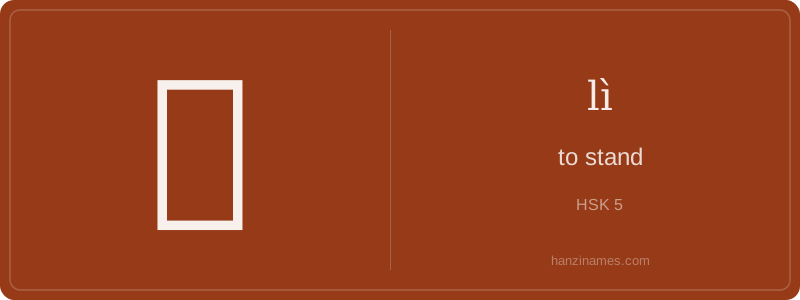
立 appears in foundational Classical Chinese texts like the Analects (e.g., 《论语·为政》: '三十而立' — 'At thirty, one stands' — meaning moral and social maturity). It’s central in legal and institutional language: 立法 (lìfǎ, 'to enact law') has been used since the Qin Dynasty’s standardization of written law, and remains the official term for legislative action in modern China and Taiwan. Common idioms include 立竿见影 (lì gān jiàn yǐng, 'set up a pole and see its shadow' — immediate effect) and 自立 (zìlì, 'self-reliance'), a core value promoted in education and policy since the early PRC era.
Archaeologically, 立 is a clear pictograph in oracle bone script (c. 1200 BCE): it depicts a person (大) standing upright on a base (一), emphasizing vertical posture and groundedness. The modern form preserves this essence—five strokes forming a stable, centered figure—making it one of the most transparently iconic characters in the system.
The character 立 (lì) embodies more than physical posture—it signifies presence, agency, and moral uprightness in Chinese thought. To ‘stand’ is to take a position: ethically, socially, or politically. Confucian texts repeatedly use 立 to describe the mature person who ‘stands firm in virtue’ (立德), reflecting a worldview where stability arises not from passive endurance but from conscious, grounded commitment.
In traditional cosmology, standing upright aligns humans with Heaven (天) above and Earth (地) below—making 立 a microcosm of cosmic order. The human body as a vertical axis mirrors the pillar-like role of the junzi (noble person): neither bending to power nor collapsing under pressure. This verticality echoes in architecture (e.g., standing pillars in temple halls) and calligraphy (where balanced, erect stroke structure conveys integrity).
Even in modern usage, 立 retains its weight beyond literal stance: to ‘establish’ a law (立法), ‘found’ a company (立公司), or ‘assert’ one’s dignity (立尊严) all draw on the same root idea—intentional, unshakable positioning. Thus, 立 is not just a verb but a philosophical anchor: to stand is to exist with purpose, clarity, and relational responsibility within the web of human and natural order.
Example Sentences
Common Compounds
Similar Characters — Don't Mix These Up
Your First Step into Chinese Culture: Get a Chinese Name
Every journey into Chinese begins with a name. Use our free Chinese name generator to create a meaningful, personalized Chinese name that fits you perfectly.
Get My Chinese Name →