竹
Character Story & Explanation
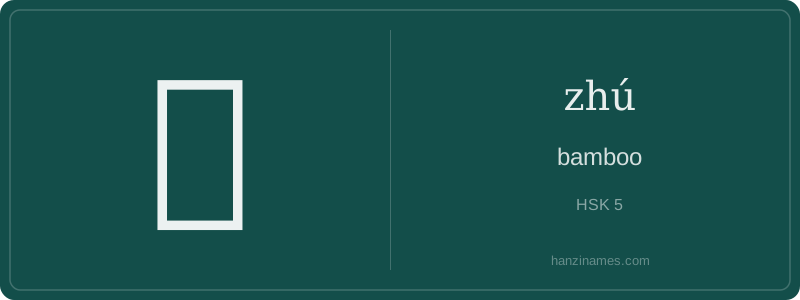
竹 remains deeply embedded in daily life: it names everyday objects (竹筷 zhúkuài, bamboo chopsticks), appears in idioms like ‘胸有成竹’ (xiōng yǒu chéng zhú, ‘to have a fully formed plan,’ lit. ‘have finished bamboo in one’s chest’—from Song dynasty painter Wen Tong’s mastery of bamboo painting), and dominates traditional architecture and musical instruments (e.g., the dizi flute). Historically, bamboo slips (竹简, zhújiǎn) served as China’s primary writing medium for over a millennium before paper.
The character is a documented pictograph: oracle bone and bronze inscriptions (c. 1200 BCE) show two parallel vertical lines with diagonal strokes branching outward—clearly representing bamboo stalks with nodes and leaves. This visual origin is confirmed by Shuōwén Jiězì (121 CE), which defines 竹 as ‘the name of a plant; its leaves are like arrows.’
Unearthing this character feels like brushing dust from a Han dynasty bamboo slip—its two symmetrical 'bamboo leaf' components (⺮) emerge as a deliberate, elegant pictographic echo of bamboo stalks splitting into paired fronds. Unlike abstract later forms, 竹 preserves an early visual logic: each side mirrors the other, evoking the bilateral symmetry of real bamboo culms and their feathery branches. This isn’t mere stylization—it’s a fossilized observation, carved in ink and memory.
Archaeological inscriptions confirm that by the Warring States period (475–221 BCE), 竹 already functioned as both semantic indicator and phonetic component in compound characters like 笔 (bǐ, brush)—a tool literally made from bamboo. Its radical form ⺮ appears in over 200 characters related to writing, music, and construction, testifying to bamboo’s foundational role in pre-paper Chinese material culture. The character is less a symbol than a technological signature.
The six-stroke structure reveals disciplined craftsmanship: two vertical strokes anchor the form, while four precise, curved ‘leaf’ strokes radiate outward—mirroring how bamboo grows: upright, resilient, and rhythmically segmented. Even its stroke order (left radical first, then right) mimics the way artisans split bamboo culms—always beginning on the left side of the node. This isn’t calligraphy; it’s embodied ethnobotany, encoded in gesture and line.
Example Sentences
Common Compounds
Similar Characters — Don't Mix These Up
Your First Step into Chinese Culture: Get a Chinese Name
Every journey into Chinese begins with a name. Use our free Chinese name generator to create a meaningful, personalized Chinese name that fits you perfectly.
Get My Chinese Name →