筑
Character Story & Explanation
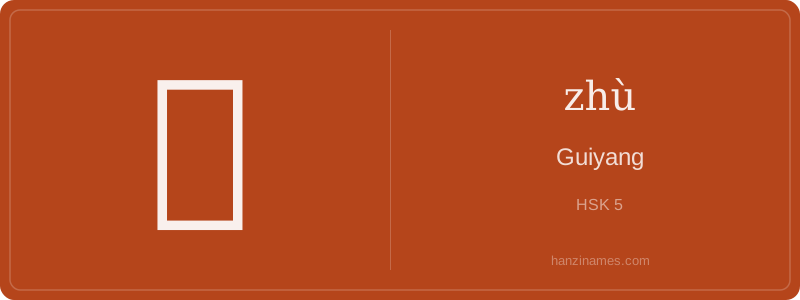
In contemporary Chinese life, 筑 appears most frequently as the abbreviated name for Guiyang in transportation signage (e.g., high-speed rail tickets labeled '贵阳/筑'), news headlines ('筑城喜迎亚运嘉宾'), and local government communications. It’s also embedded in the city’s cultural branding—Guiyang’s official tourism slogan sometimes features '爽爽贵阳·筑梦未来' ('Refreshing Guiyang—Building Dreams in Zhu'). Historically, the character entered geographical shorthand during the Republican era (1912–1949), when provincial capitals adopted one-character abbreviations based on classical names or local landmarks.
The character 筑 is not a pictograph. Its earliest attested form (in seal script) combines ⺮ (bamboo) and 祝 (a phonetic component). While some older dictionaries link it to the ancient bamboo zither (zhu, an instrument), its use for Guiyang is purely conventional—adopted because 'Guiyang' was historically called 'Juzhou' (筑州) during the Tang Dynasty, later shortened to 筑. No oracle bone or bronze inscription confirms a direct pictorial origin.
Hello students! The character 筑 (zhù) is a fascinating example of how Chinese characters can carry both ancient meaning and modern geographical significance. While its original meaning relates to 'building' or 'constructing'—a sense still alive in words like 建筑 (jiànzhù, 'architecture')—today it’s most commonly encountered as the official short name for Guiyang, the capital city of Guizhou Province. This dual identity makes it especially interesting for learners: you’ll see it on train tickets, maps, and government documents referring to Guiyang.
Don’t confuse this with the homophone 竹 (zhú, 'bamboo'), even though both share the bamboo radical ⺮. Here, the top part 竹 indicates material or category (historically linked to bamboo scaffolding or instruments), while the bottom part 祝 (zhù) hints at pronunciation—but this is a phonetic loan, not semantic. As an HSK 5 character, it appears in intermediate-to-advanced reading contexts, especially in geography, urban development, or cultural reports about Southwest China.
Remember: when you see 筑 used alone in modern writing—especially in news headlines, transport signs, or official announcements—it almost always stands for Guiyang. For example, '筑城' (Zhùchéng) literally means 'Zhu City', but it’s a poetic, widely accepted nickname for Guiyang, just like '沪' for Shanghai or '津' for Tianjin. Learning this helps you read real-world Chinese more fluently and recognize regional shorthand used by native speakers daily.
Example Sentences
Common Compounds
Similar Characters — Don't Mix These Up
Your First Step into Chinese Culture: Get a Chinese Name
Every journey into Chinese begins with a name. Use our free Chinese name generator to create a meaningful, personalized Chinese name that fits you perfectly.
Get My Chinese Name →