糊
Character Story & Explanation
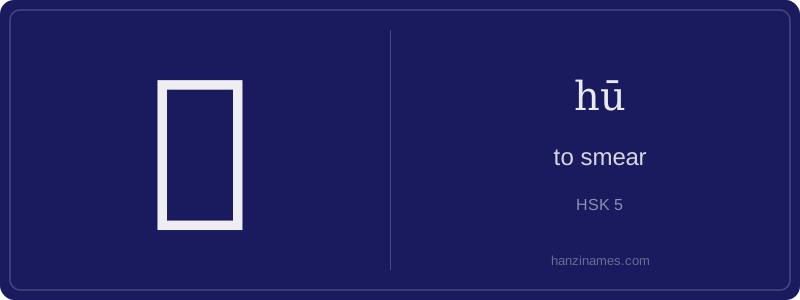
In Beijing’s hutongs, elderly artisans still hand-paste silk onto wooden window frames using rice paste—saying they ‘糊窗纸’ (hū chuāngzhǐ, smear paper onto windows) to seal drafts before winter. This traditional use persists in cultural preservation projects and is documented in the *Compendium of Materia Medica* (Bencao Gangmu), which notes ‘米糊’ (mǐhú, rice paste) as both adhesive and medicinal binder. The phrase 糊弄 (hùnong, to deceive) dates to Qing-dynasty vernacular fiction, where ‘smearing over’ truth became a metaphor for deceit.
The character’s 米 radical confirms its origin in grain-based pastes; archaeological evidence shows rice-starch adhesives were used in Han dynasty lacquerware repair. No oracle-bone or bronze script forms survive, but early seal script (c. 3rd c. BCE) already shows 米 + 胡 (a phonetic component), indicating its original meaning was tied to sticky, starchy substances—not abstract concepts.
The character 糊 (hū) evokes the tactile, everyday act of applying a viscous substance—like paste or glue—to bind or coat something. Its 米 (rice) radical signals its historical link to starchy pastes made from ground rice or wheat flour, long used in Chinese paper crafts, bookbinding, and traditional construction. Though now often replaced by synthetic adhesives, this grain-based origin remains embedded in the character’s form and function.
While hū is the most common pronunciation for the verb ‘to smear’, the alternate readings hú and hù appear in fixed expressions: hú in 糊弄 (hùnong, to deceive) and hù in rare dialectal or literary usage. These tonal shifts reflect semantic specialization—hū emphasizes physical application, hú implies deception through superficial coverage, and hù is largely archaic or regional.
At HSK Level 5, 糊 appears in nuanced contexts beyond literal smearing—especially in idioms like 糊里糊涂 (húlǐhútú, muddled and confused), where the ‘covering’ sense metaphorically extends to mental obscurity. This layering—physical action → surface concealment → cognitive fog—is central to mastering the character’s expressive range in modern Mandarin.
Example Sentences
Common Compounds
Similar Characters — Don't Mix These Up
Your First Step into Chinese Culture: Get a Chinese Name
Every journey into Chinese begins with a name. Use our free Chinese name generator to create a meaningful, personalized Chinese name that fits you perfectly.
Get My Chinese Name →