糙
Character Story & Explanation
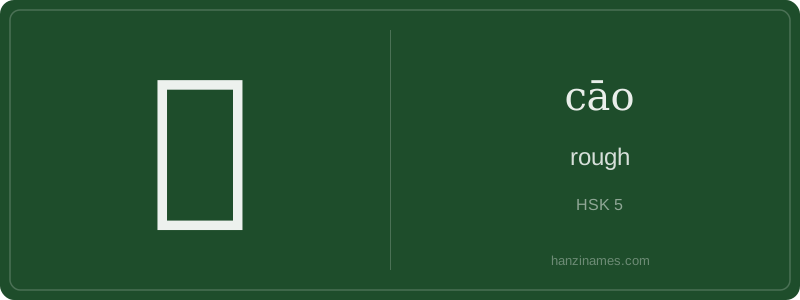
In modern Chinese, 糙 most commonly appears in compounds like 糙米 (cāomǐ, 'brown rice') — a staple food term widely used in nutrition, agriculture, and supermarket labeling across China. It also features in the idiom 粗糙 (cūcāo, 'coarse/rough'), frequently critiquing low-quality manufacturing or careless writing. Historically, the character appears in Ming–Qing agricultural manuals describing unmilled grain varieties, and in Qing-era craft records distinguishing 'rough' vs. 'polished' lacquerware finishes.
The character is not pictographic — no oracle bone or bronze inscriptions exist for 糙. It first appears in standardized clerical script (c. 2nd century BCE–2nd century CE) as a phono-semantic compound. Today, Chinese speakers routinely use it when shopping for whole grains, reviewing product quality ('这做工太糙了' — 'The craftsmanship is too rough!'), or joking about someone’s '糙汉子' (cāo hànzi, 'rough-and-tumble guy') persona.
Our detective work begins at the scene: the character 糙 (cāo), meaning 'rough' — but not just tactile roughness. It’s the grit in unpolished rice, the coarseness of unfinished wood, the bluntness of a hastily spoken truth. Its radical 米 (mǐ, 'rice') immediately clues us in: this isn’t abstract roughness — it’s *material*, grounded in agriculture and grain processing. Ancient Chinese milling left bran and husk fragments; that imperfect, uneven texture became the semantic anchor.
Zooming in on the right side — 造 (zào, 'to make, create') — we find the phonetic component. Though pronounced cāo today, it shares historical phonetic kinship with zào (both from Middle Chinese *tsʰau). This is no accident: 'rough' here implies something *made hastily or without refinement* — like a crudely 'constructed' surface. The character thus encodes both origin (rice) and process (making), merging physical texture with human action.
Unlike pictographs frozen in time, 糙 evolved through script standardization: from clerical script’s balanced strokes to regular script’s crisp 16-stroke form. Its HSK 5 status reflects its functional nuance — not basic vocabulary, but essential for describing quality, craftsmanship, or even personality ('a rough-mannered person'). It appears in technical texts (e.g., material science), literary critique ('rough draft'), and daily speech — always carrying that tangible, slightly imperfect weight.
Example Sentences
Common Compounds
Similar Characters — Don't Mix These Up
Your First Step into Chinese Culture: Get a Chinese Name
Every journey into Chinese begins with a name. Use our free Chinese name generator to create a meaningful, personalized Chinese name that fits you perfectly.
Get My Chinese Name →