绸
Character Story & Explanation
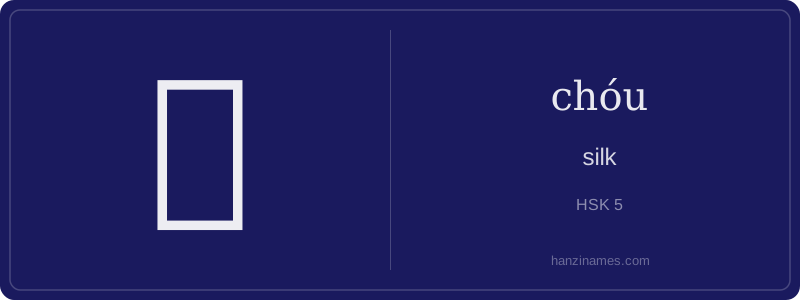
绸 is widely used in modern Mandarin to denote silk fabric — especially in commercial, fashion, and craft contexts. You’ll see it on garment labels (真丝绸, zhēn sīchóu, 'pure silk'), in textile markets, and in idioms like 绸缪帷幄 (chóumóu wéiwò, 'to prepare meticulously in advance', originally referring to securing tents with silk ropes). Historically, silk was state-regulated; Tang dynasty legal codes specified fines for unauthorized silk dyeing, and Song dynasty records list 绸 among taxed luxury textiles. Today, Hangzhou and Suzhou remain famed for hand-woven 绸.
The character is not pictographic — no ancient bone inscriptions depict it. Instead, it emerged during the Han dynasty as a phono-semantic compound. In daily life, Chinese speakers use 绸 in compound words far more often than alone; you’ll rarely hear someone say just 'chóu' without context — it’s almost always part of a term like 缎绸 (duànchóu, 'damask silk') or 绸布 (chóubù, 'silk fabric').
As a linguistic detective, I begin with the radical: 纟 (sī), the ‘silk’ or ‘thread’ radical — one of the most textile-associated components in Chinese script. It appears on the left of 绸 and signals that this character belongs to the semantic field of fabrics, weaving, or fine materials. This radical itself evolved from the ancient character for ‘silk thread’ (糸), simplified over centuries into its modern three-stroke form. Its presence is the first clue: this character is fundamentally about silk — not just as a material, but as a cultural signifier of luxury, craftsmanship, and refinement.
Next, the right side, 周 (zhōu), serves as the phonetic component. While 周 means ‘week’, ‘cycle’, or ‘all-around’, here it primarily provides the sound chóu — a close approximation of its Middle Chinese pronunciation *dʒɨu. Phonetic loans like this are common in Chinese characters: the shape hints at meaning (via the radical), while the right-hand part hints at pronunciation. Interestingly, 周 also subtly reinforces meaning — silk production in ancient China was deeply tied to regional specialization and cyclical sericulture practices, echoing the ‘completeness’ and ‘systematicness’ implied by 周.
Tracing further, we find no oracle bone or bronze script forms for 绸 — it’s a relatively late-comer, first appearing reliably in Han dynasty bamboo slips and clerical script texts. Its emergence coincides with the Silk Road’s expansion and the bureaucratic codification of textile taxation and tribute. Unlike older pictographs, 绸 is a classic phono-semantic compound: functional, systematic, and historically grounded in China’s imperial textile economy. Its 11 strokes reflect careful balance — three for the radical, eight for 周 — embodying the precision required in both silk weaving and character writing.
Example Sentences
Common Compounds
Similar Characters — Don't Mix These Up
Your First Step into Chinese Culture: Get a Chinese Name
Every journey into Chinese begins with a name. Use our free Chinese name generator to create a meaningful, personalized Chinese name that fits you perfectly.
Get My Chinese Name →