缩
Character Story & Explanation
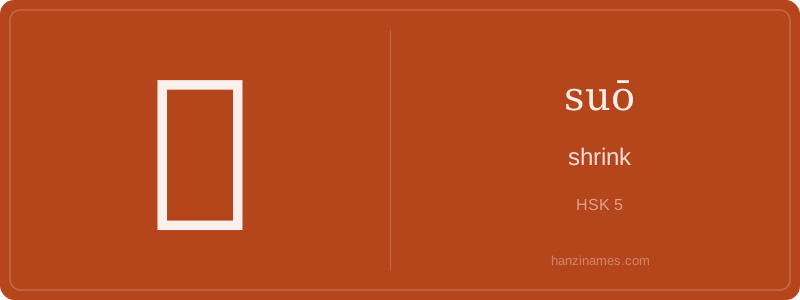
缩 is widely used in contemporary Chinese media and policy language. For example, China’s 'supply-side reform' (供给侧改革) frequently references 缩减产能 ('reduce excess production capacity') — a documented economic term since 2015. It also appears in idioms like 缩手缩脚 (suō shǒu suō jiǎo), meaning 'timid and hesitant', recorded in Ming-dynasty vernacular literature. In digital life, 缩略图 (suōlüètú, 'thumbnail') is ubiquitous on WeChat and Bilibili.
The character’s form is not pictographic but phono-semantic: left radical 纟 hints at tension/tightening (from silk threads), while right component 宿 serves mainly as a sound cue (though its pronunciation diverged over time). No oracle-bone or bronze inscriptions of 缩 exist — it first appeared reliably in clerical script during the Han dynasty (206 BCE–220 CE).
Hi students! The character 缩 (suō) means 'to withdraw', 'to shrink', or 'to contract'. It’s a verb used when something pulls back, reduces in size, or becomes smaller — like a rubber band snapping back or a company cutting staff. Though it looks complex with 14 strokes, notice its left side 纟 (sī), the 'silk' radical — historically linked to threads that can tighten or coil, giving a visual clue to its meaning of contraction.
This character appears often in modern Chinese, especially in formal or technical contexts: economics (e.g., 缩减 'to reduce'), technology (e.g., 缩放 'to zoom'), and daily life (e.g., 衣服缩水 'clothes shrink'). At HSK Level 5, it signals growing vocabulary sophistication — you’ll need it for news, reports, and nuanced expression, not just basic conversation.
Don’t confuse 缩 with similar-sounding words like 所 (suǒ) or 宿 (sù). Its pronunciation suō has a flat first tone — practice saying it slowly: 'swoh' (like 'so' but with an 'w' glide). Remember: the right side 宿 (sù) is *not* pronounced sù here — it’s a phonetic component that evolved; many learners find this surprising, but it’s a common pattern in Chinese characters!
Example Sentences
Common Compounds
Similar Characters — Don't Mix These Up
Your First Step into Chinese Culture: Get a Chinese Name
Every journey into Chinese begins with a name. Use our free Chinese name generator to create a meaningful, personalized Chinese name that fits you perfectly.
Get My Chinese Name →