耽
Character Story & Explanation
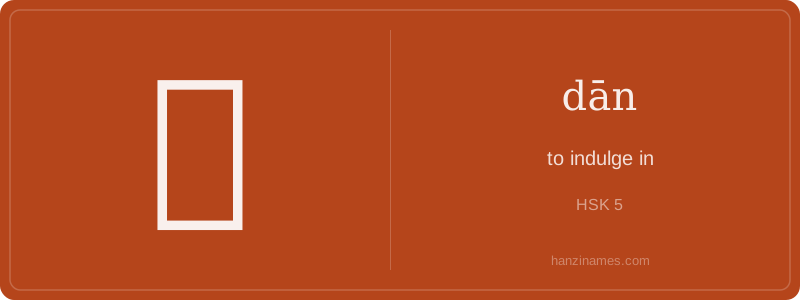
In modern Chinese, 耽 is most commonly encountered in formal or literary contexts—not daily small talk—but appears reliably in idioms like 耽误 (dānwù, 'to delay/impede') and the classical phrase 耽于逸乐 (dān yú yì lè, 'indulge in ease and pleasure'), cited in historical critiques of rulers. It's also central to the term 耽美 (dānměi), a genre label for BL (boys’ love) fiction, borrowed from Japanese in the 1990s—showcasing its enduring association with aesthetic, emotionally intense absorption.
The character’s origin is not pictographic but phono-semantic: 耳 (ear) serves as the semantic component (suggesting 'attention' or 'perception'), while 冘 (yín) functions phonetically. No oracle bone or bronze script forms survive; earliest attested use is in Warring States bamboo texts. Today, Chinese learners encounter it first in HSK 5 vocabulary lists, often through compound words emphasizing consequence—e.g., 耽误 implies delay with negative impact, not neutral waiting.
Unearthing 耽 (dān) feels like brushing dust from a Han dynasty bamboo slip—its form stable, its meaning layered with moral gravity. The ear radical (耳) anchors it not to hearing, but to *attentiveness*: in ancient thought, deep listening was synonymous with absorption. The right side, 冘 (yín), originally depicted a person hesitating or lingering—suggesting arrested motion, not passive idleness. This duality—focused attention + suspended action—reveals how early scribes encoded psychological nuance into structure.
Unlike characters for mere 'delay' (如 迟 chí) or 'leisure' (如 闲 xián), 耽 carries ethical weight: Confucian texts warn against 耽于声色 ('indulging in sounds and colors') as a path to moral erosion. Its ten strokes—precise, balanced, neither hurried nor slack—mirror the character’s semantic tension: indulgence as both immersive engagement and dangerous over-absorption. The stroke order itself enacts this: beginning firmly with the ear, then unfolding the ‘lingering’ component with deliberate, downward strokes.
Archaeologically, 耽 appears consistently in excavated texts from the Western Han onward—not as slang, but as a calibrated term in philosophical and administrative discourse. Its stability across 2,000 years testifies to its conceptual precision: it never meant simple 'delay', nor pure 'pleasure', but specifically *prolonged, self-aware immersion* that risks imbalance. Modern usage preserves this gravity—it’s rarely used lightly, appearing most often in critiques of excess or in literary introspection, where the 'ear' reminds us: true indulgence begins with what we choose to attend to.
Example Sentences
Common Compounds
Similar Characters — Don't Mix These Up
Your First Step into Chinese Culture: Get a Chinese Name
Every journey into Chinese begins with a name. Use our free Chinese name generator to create a meaningful, personalized Chinese name that fits you perfectly.
Get My Chinese Name →