肃
Character Story & Explanation
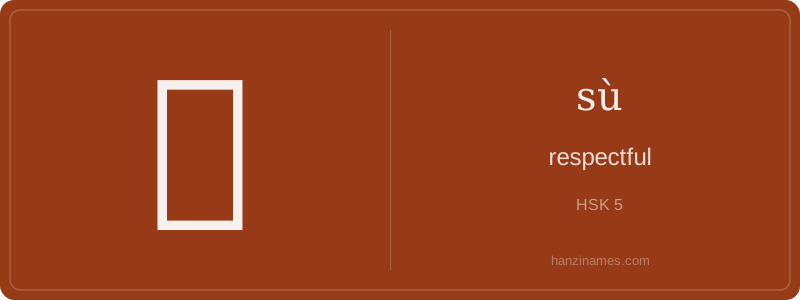
肃 appears frequently in formal and institutional contexts: government documents use '严肃' (yán sù, 'serious/solemn') to denote rigor in law enforcement; schools display '肃立' (sù lì, 'stand respectfully') during national flag ceremonies; and classical idioms like '肃然起敬' (sù rán qǐ jìng, 'to stand in awe and reverence') remain common in speeches and literature. The term '肃反' (sù fǎn, 'suppress counter-revolutionaries') was historically used in mid-20th-century political campaigns, reflecting the character’s association with authoritative discipline.
The character 肃 evolved from seal script (c. 3rd c. BCE), where it depicted a person kneeling with hands bound—a gesture of submission and solemnity. Though its earliest oracle-bone form is lost, the small seal script shows clear components: 肀 (yù, 'to govern') as radical, and 厶 (sī, archaic 'private' or 'hidden') + 丨 (gǔn, 'vertical line'), suggesting controlled, inward-directed action—consistent with its meaning of respectful restraint.
肃 (sù) embodies a profound Confucian ideal: respect not as passive deference, but as disciplined self-restraint and solemn attentiveness. In traditional Chinese worldview, true reverence manifests in stillness—quieting the body, calming the breath, and focusing the mind. This inner composure reflects harmony with cosmic order (li 理), where human conduct aligns with ritual propriety (lǐ 礼). Thus, 肃 is less about emotion and more about embodied ethics—how one stands, speaks, and listens in sacred or authoritative spaces.
The character’s gravity extends beyond interpersonal courtesy into governance and cosmology. Historically, imperial edicts began with phrases like ‘肃命’ (sù mìng, 'solemnly command') to signify heavenly mandate enacted through disciplined authority. Even today, '肃静' (sùjìng) isn’t merely 'be quiet'—it’s an invocation of collective mindfulness, echoing Daoist reverence for stillness as the source of wisdom and Buddhist emphasis on serene awareness.
Unlike Western notions of respect rooted in individual recognition, 肃 expresses relational integrity: honoring hierarchy, ancestry, and shared values through measured presence. Its eight-stroke form—compact, upright, and unadorned—mirrors its semantic essence: no flourish, no excess, only focused dignity. To cultivate 肃 is to practice humility before tradition, elders, and truth itself—a quiet revolution against distraction and arrogance in modern life.
Example Sentences
Common Compounds
Similar Characters — Don't Mix These Up
Your First Step into Chinese Culture: Get a Chinese Name
Every journey into Chinese begins with a name. Use our free Chinese name generator to create a meaningful, personalized Chinese name that fits you perfectly.
Get My Chinese Name →