肌
Character Story & Explanation
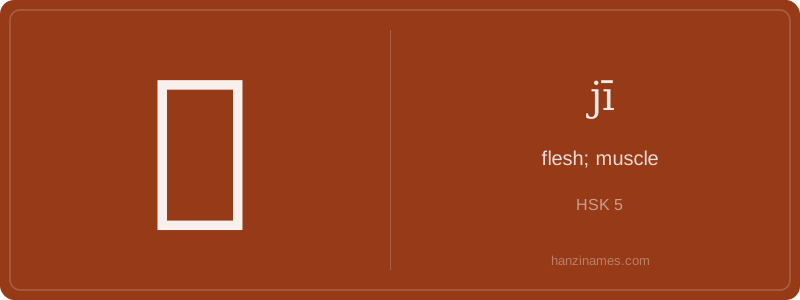
肌 is widely used in modern Chinese in medical terminology (e.g., 肌无力 jī wúlì 'myasthenia gravis'), skincare advertising (e.g., '紧致肌底' jǐnzhì jīdǐ 'firming muscle base'), and idioms like 面黄肌瘦 (miàn huáng jī shòu 'sallow complexion and emaciated muscles'), a classical phrase from Ming dynasty literature describing severe malnutrition. It also appears in standardized HSK 5 vocabulary lists and national medical textbooks.
肌 is a phono-semantic compound: the left radical ⺼ ('flesh') indicates meaning; the right component 几 (jī) provides phonetic approximation. This structure dates to the Han dynasty clerical script and remains unchanged in modern standard writing. No oracle-bone or bronze inscription evidence exists for 肌—it first appears reliably in early medical texts like the Huangdi Neijing (c. 2nd century BCE), referring to muscular tissue in acupuncture theory.
The Chinese character 肌 (jī) literally means 'flesh' or 'muscle' and functions primarily as a noun in anatomical, medical, and cosmetic contexts. Unlike English, where 'muscle' and 'flesh' are distinct lexically—'muscle' emphasizing contractile tissue and 'flesh' denoting soft body tissue—肌 unifies both concepts, often implying the visible, tactile layer beneath skin. It appears in formal registers more than casual speech, reflecting Chinese linguistic preference for compound words over standalone monosyllables.
In Western biomedical tradition, muscle is studied as a functional organ system (e.g., skeletal, cardiac), while 'flesh' carries literary or theological connotations (e.g., 'the flesh' in Christian discourse). In contrast, 肌 is strictly somatic and secular: it appears in clinical terms like 肌肉 (jīròu, 'muscle') and cosmetic phrases like 肌肤 (jīfū, 'skin and flesh'), where it evokes texture, tone, and vitality—not sin or mortality.
Culturally, 肌 reflects East Asian holistic body perception: it rarely stands alone but pairs with other body-related characters (e.g., 皮 'skin', 肤 'dermis', 肉 'meat/flesh') to form precise compound nouns. This mirrors traditional Chinese medicine’s emphasis on interrelated tissue layers rather than isolated organs. While Western fitness culture celebrates 'muscle mass', Chinese wellness discourse prioritizes 肌理 (jīlǐ, 'muscle texture')—a concept tied to balance, qi flow, and outward radiance—making 肌 a subtle marker of health and refinement.
Example Sentences
Common Compounds
Similar Characters — Don't Mix These Up
Your First Step into Chinese Culture: Get a Chinese Name
Every journey into Chinese begins with a name. Use our free Chinese name generator to create a meaningful, personalized Chinese name that fits you perfectly.
Get My Chinese Name →