背
Character Story & Explanation
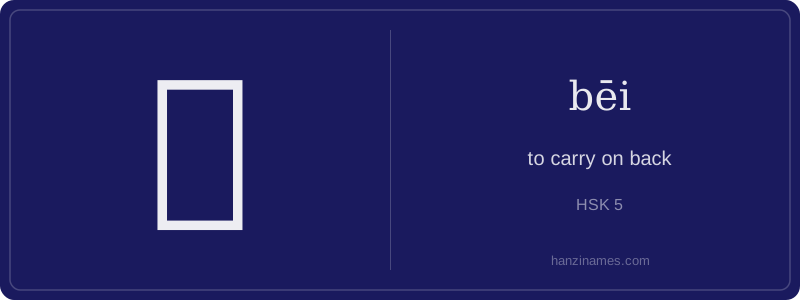
In contemporary China, 背 (bēi) is routinely used in transportation contexts—bike couriers in Shanghai say 我背个包去送货 (wǒ bēi gè bāo qù sòng huò, 'I’ll carry a bag to deliver')—and in education, where students 背课文 (bèi kèwén, 'recite texts') as part of standardized test prep. The idiom 背道而驰 (bèi dào ér chí, 'to go in opposite directions') appears in official media to describe policy contradictions. It’s also central to legal phrases like 背信弃义 (bèi xìn qì yì, 'to betray trust and justice'), widely cited in anti-corruption campaigns.
The character’s form evolved from seal script, where the left side ⺼ represents the body, and the right side 北 originally depicted two people facing away—symbolizing ‘turning one’s back’. By Han dynasty, it standardized into its current shape, retaining both the physical and metaphorical sense of ‘back’ and ‘bearing’.
Imagine a grandmother in Chengdu’s narrow alleyways, adjusting a woven bamboo basket on her back—her posture steady, muscles taut, shoulders bearing the weight of fresh vegetables for lunch. This is 背 (bēi): not just a verb, but a physical act of support, endurance, and quiet responsibility. In daily life, it captures how people carry more than objects—they carry family, duty, memory.
The character’s dual pronunciation reflects its semantic duality: bēi emphasizes active carrying (e.g., carrying luggage), while bèi shifts to passive states—‘to bear’ emotionally (as in 背债, ‘to shoulder debt’) or ‘to memorize’ (背诵), where knowledge is carried inward like a burden or treasure. This nuance mirrors Confucian ideals of moral weight and self-cultivation.
Historically, 背 appears in Tang dynasty poetry describing porters hauling grain along the Grand Canal, and today it surfaces in modern idioms like 背水一战 (bèi shuǐ yī zhàn)—‘fighting with one’s back to the river’, meaning a desperate, no-retreat stand. Its radical ⺼ (flesh/body) grounds it in the human body, reminding us that meaning in Chinese often begins with lived, embodied experience.
Example Sentences
Common Compounds
Similar Characters — Don't Mix These Up
Your First Step into Chinese Culture: Get a Chinese Name
Every journey into Chinese begins with a name. Use our free Chinese name generator to create a meaningful, personalized Chinese name that fits you perfectly.
Get My Chinese Name →