胁
Character Story & Explanation
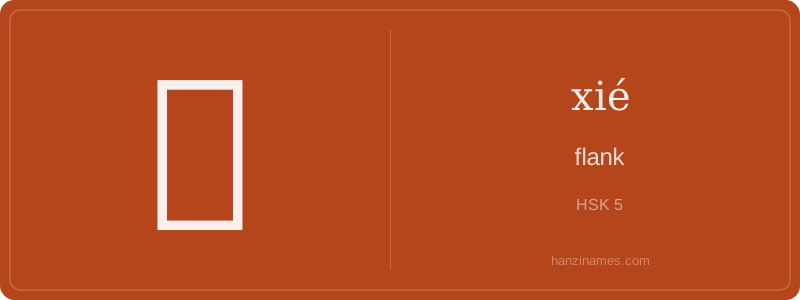
In modern Mandarin, 胁 is rarely used alone but appears critically in legal, political, and literary contexts. It features in the HSK-5 idiom 胁迫 (xiépò, 'coerce') and the classical phrase 胁肩谄笑 (xié jiān chǎn xiào, 'to hunch one’s shoulders and fawn'), documented in the Mencius (c. 300 BCE) to criticize sycophantic behavior. Its use in official documents (e.g., '胁迫他人' — 'to coerce another person') reflects strict legal terminology under China’s Criminal Law Article 274.
The character’s origin is not pictographic like 日 or 木; it’s a phono-semantic compound. The ⺼ radical denotes body-related meaning, while 协 (xié) provides pronunciation and conveys 'joint action'—later extended to 'pressuring from the side', aligning with the flank’s strategic role in ancient military formations.
As a detective tracing 胁’s evolution, I begin at its skeletal core: the ⺼ (flesh/body) radical—unmistakably anchoring it to the human form. In ancient bronze inscriptions, 胁 appeared as a compound of ⺼ and 協 (xié, 'to assist'), suggesting early conceptual links between the body’s side and coordinated action—perhaps referencing how flanks support movement or defense in warfare.
By the Han dynasty, the character stabilized into its modern shape: ⺼ + 协 (simplified from 協), with 协 providing both phonetic guidance (xié) and semantic nuance—implying cooperation, yet paradoxically evolving toward coercion. This duality foreshadows its later shift from anatomical neutrality to psychological pressure, where 'flank' becomes metaphorical leverage.
The eight-stroke structure reveals disciplined craftsmanship: first the flesh radical (4 strokes), then 协’s four strokes—two horizontal sweeps, a dot, and a final捺 (nà) stroke. Every stroke is purposeful; no flourish distracts from its functional clarity. This economy reflects Classical Chinese’s precision: one character, layered meanings—physical location, strategic vulnerability, and social compulsion—all converging in a single, compact glyph.
Example Sentences
Common Compounds
Similar Characters — Don't Mix These Up
Your First Step into Chinese Culture: Get a Chinese Name
Every journey into Chinese begins with a name. Use our free Chinese name generator to create a meaningful, personalized Chinese name that fits you perfectly.
Get My Chinese Name →