舅
Character Story & Explanation
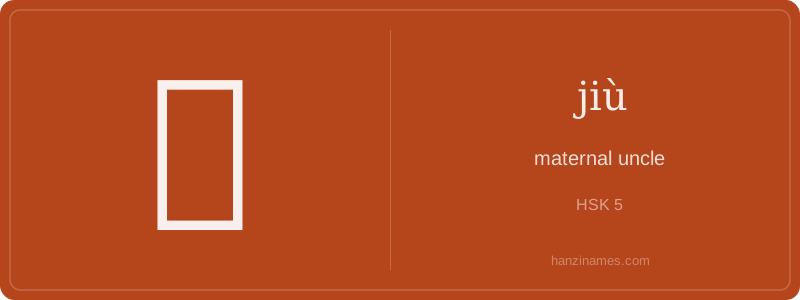
In contemporary Mandarin, 舅 is used formally and affectionately to address or refer to one’s maternal uncle—never paternal. It appears in fixed phrases like 舅舅 (jiùjiu, ‘uncle’ with reduplication for familiarity) and in bureaucratic contexts such as household registration (hùkǒu) forms, where kinship fields distinguish maternal vs. paternal relatives. Historically, the Rites of Zhou prescribed distinct mourning periods for 舅 (5 months) versus paternal uncles (3 months), underscoring its institutional weight.
The character is not pictographic; its form evolved from seal script (c. 3rd c. BCE), where 臼 served purely as a phonetic indicator. Modern learners should note that its 13 strokes follow a set order: start with the two dots of 臼, then complete the ‘mortar’ frame before adding 男 and 畐. No oracle-bone form exists—it entered writing fully formed during the Eastern Zhou transition to clerical script.
As an archaeologist sifting through layers of linguistic sediment, I find 舅 (jiù) not carved on oracle bones but etched deeply into kinship structures. Its earliest attestation appears in the Warring States bamboo texts and the Han dynasty’s Erya, where it consistently denotes the mother’s brother — a role legally and ritually distinct from paternal uncles (伯父, shūfù). This semantic precision reflects ancient China’s matrilineal traces and the enduring weight of maternal lineage in inheritance, mourning rites, and marriage prohibitions.
The character’s composition—radical 臼 (jiù, ‘mortar’) atop 男 (nán, ‘man’) and 畐 (fú, a phonetic component)—is misleading at first glance. 臼 here is not literal but a phonetic loan: in Old Chinese, 臼 and 舅 shared near-identical pronunciation (*kruʔ), making it a classic ‘phonosemantic compound’. No mortar was involved; instead, sound guided form, a common strategy when abstract kinship terms lacked pictorial referents.
What emerges is not a fossilized relic but a living artifact: 舅 persists in legal codes (e.g., the Republic of China Civil Code Article 1138), genealogical records, and modern family interviews across Fujian and Guangdong, where maternal uncles still officiate at weddings or mediate property disputes. Its stability over 2,300 years signals how deeply Confucian kinship grammar is embedded—not in stone, but in speech, law, and daily address.
Example Sentences
Common Compounds
Similar Characters — Don't Mix These Up
Your First Step into Chinese Culture: Get a Chinese Name
Every journey into Chinese begins with a name. Use our free Chinese name generator to create a meaningful, personalized Chinese name that fits you perfectly.
Get My Chinese Name →