良
Character Story & Explanation
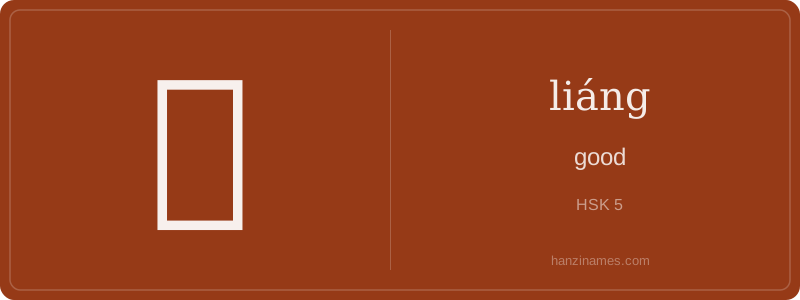
良 is deeply embedded in modern Chinese usage — especially in ethical and institutional language. It appears in the widely taught idiom 良知 (liáng zhī, 'moral conscience'), rooted in Confucian philosophy and still invoked in education and media. Government reports frequently use 良好 (liáng hǎo) to describe 'sound' economic conditions or 'healthy' social development. Medical professionals say 良性 (liáng xìng, 'benign') for non-cancerous tumors — a standardized term codified in China’s national medical terminology guidelines.
The character’s earliest confirmed form appears in bronze inscriptions from the Western Zhou dynasty (c. 1046–771 BCE), where it resembled a stylized 'person lying down peacefully' — symbolizing rest, safety, and thus 'well-being' or 'goodness'. While oracle bone forms are uncertain, the bronze script meaning aligns consistently with 'favorable, sound, virtuous' across historical texts.
Hello students! The character 良 (liáng) is a foundational word meaning 'good' — but not just in a casual way. It carries weight: think 'inherently good', 'sound', 'excellent', or 'virtuous'. You’ll see it often in formal, moral, or technical contexts — like 'good quality' or 'good intentions'. It’s not the everyday 'good' you’d use for tasty food (that’s 更好 or 棒); instead, 良 suggests reliability, integrity, and excellence rooted in tradition.
Visually, 良 has 7 strokes and belongs to the 艮 (gèn) radical — which originally meant 'stillness' or 'limit' in ancient texts and now mostly serves as a structural marker. Don’t confuse it with simpler 'good' words like 好 (hǎo). 良 feels more solemn — it’s the 'good' you’d find in classical poetry, medical terms (e.g., 良心 'conscience'), or official documents.
At HSK Level 5, 良 appears in compound words rather than alone. Native speakers rarely say just '良!' — it’s almost always part of a two-character word. That’s key: mastering 良 means mastering its partnerships — like 良好 (liáng hǎo, 'good/healthy'), 良心 (liáng xīn, 'conscience'), or 良机 (liáng jī, 'golden opportunity'). Think of it as a respectful, mature 'good' — one that earns trust.
Example Sentences
Common Compounds
Similar Characters — Don't Mix These Up
Your First Step into Chinese Culture: Get a Chinese Name
Every journey into Chinese begins with a name. Use our free Chinese name generator to create a meaningful, personalized Chinese name that fits you perfectly.
Get My Chinese Name →