豆
Character Story & Explanation
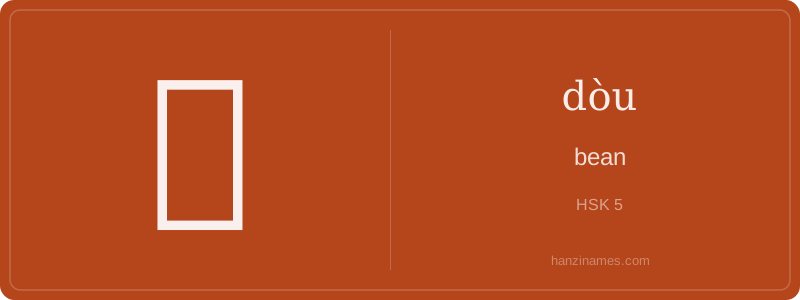
Historically, 豆 named both the ancient bronze food vessel and the legumes served in it—verified by inscriptions on Shang-Zhou bronzes and definitions in the *Shuōwén Jiězì*. In daily use today, it appears in ubiquitous terms like 黄豆 (huángdòu, soybean), 红豆 (hóngdòu, adzuki bean), and the idiom 两豆塞耳 (liǎng dòu sāi ěr, 'two beans block the ears'), meaning willful ignorance—first recorded in the *Huáinánzǐ* (2nd c. BCE). It's also used as a rare measure word for small round items (e.g., 一豆灯, 'a tiny lamp').
The character is a verified pictograph: oracle bone and bronze inscriptions clearly depict a high-footed dish with a rounded bowl and flared base—matching over 200 excavated Zhou-dynasty bronze dòu vessels. No scholarly dispute exists; the archaeological and paleographic evidence is unambiguous and publicly documented in the *Jiǎgǔwén Héjí* and Shanghai Museum collections.
As an archaeologist brushing dust from a Western Zhou bronze ritual vessel, I found 豆 etched beside food offerings—its shape unmistakably that of a tall, stemmed serving dish used for boiled beans and millet. This wasn’t mere notation; it was liturgy in script. The character’s earliest attested form (c. 1000 BCE) is a pictograph: a round container atop a slender pedestal, legs splayed for stability—exactly matching excavated bronze ‘dòu’ vessels now housed in the Shanghai Museum.
Over centuries, the vessel’s function shifted—from sacred grain holder to quotidian bean bowl—and so did the character’s semantic scope. By the Warring States period, 豆 no longer just named the container but also the legumes it held. This metonymic leap mirrors how English uses 'bowl' to mean both object and its contents ('a bowl of lentils'). Linguistic stratigraphy confirms this: in the *Shuōwén Jiězì* (121 CE), Xu Shen defines 豆 explicitly as 'a vessel for grains and pulses', then adds 'also refers to the beans themselves'—documenting the semantic expansion in real time.
The character’s radical status is rare: 豆 is both a meaning-bearing component *and* an independent character—a linguistic fossil retaining full semantic autonomy. Unlike most radicals (e.g., 氵for water), 豆 never lost its lexical life. Today, it anchors compounds like 豆腐 (dòufu, 'bean curd') and 大豆 (dàdòu, 'soybean'), yet stands alone with full grammatical weight—as a noun, measure word (e.g., 一豆盐), and even in classical poetry as a symbol of humble sustenance. Its resilience reflects the bean’s own cultural endurance: staple, sacrifice, and survival food across three millennia.
Example Sentences
Common Compounds
Similar Characters — Don't Mix These Up
Your First Step into Chinese Culture: Get a Chinese Name
Every journey into Chinese begins with a name. Use our free Chinese name generator to create a meaningful, personalized Chinese name that fits you perfectly.
Get My Chinese Name →