虹
Character Story & Explanation
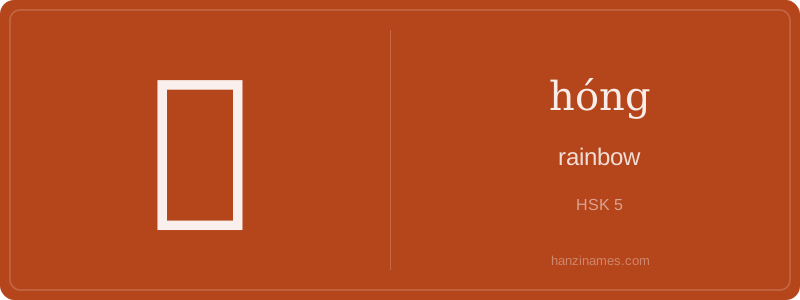
虹 appears frequently in modern Chinese in poetic, technical, and colloquial contexts: as a weather term ('rainbow'), in compound words like 彩虹 (cǎihóng, 'colorful rainbow'), and in scientific discourse (e.g., 光谱虹, 'spectral rainbow'). It features in the idiom 气贯长虹 — used since at least the Ming dynasty to describe unstoppable vigor, notably in martial arts literature and political rhetoric. Historically, 虹 was documented in oracle bone inscriptions (c. 1200 BCE) as a pictograph resembling an arching creature with head and tail — interpreted by scholars like Guo Moruo as depicting a dragon-like being curving across the sky.
The earliest attested form (Shang dynasty oracle bones) shows an arched line with simplified head and body elements, later standardized into the current structure with 虫 (insect/dragon radical) and 工 (gōng, phonetic component). Though not literally an insect, 虫 here signals its mythic, animate nature — consistent with how ancient Chinese categorized supernatural serpentine beings.
The character 虹 (hóng) embodies a profound convergence of natural observation and cosmological imagination in traditional Chinese thought. Unlike Western associations of rainbows with divine promises or bridges to heaven, classical Chinese texts viewed 虹 as a living, dual-natured entity — a celestial dragon that drinks from rivers and lakes during rain. Its inclusion under the ‘insect’ radical (虫) reflects an ancient classification system where serpentine, liminal, and transformative creatures — including dragons, scorpions, and centipedes — were grouped not by biology but by perceived vitality and yin-yang ambiguity.
This duality is key: 虹 appears only at the boundary of rain and sun — a transient harmony of water (yin) and fire/light (yang). In Daoist and Han dynasty cosmology, such phenomena signaled cosmic resonance, not mere optics. The rainbow thus became a symbol of fleeting beauty, auspicious omen, and moral clarity — appearing only when Heaven and Earth were properly aligned, making it both a meteorological event and an ethical mirror.
Even today, 虹 retains this layered resonance. While modern science explains it as light refraction, its literary and artistic usage still evokes wonder, transition, and hope — especially in poetry and children’s education. Its presence in idioms like 气贯长虹 (qì guàn cháng hóng, 'spirit surging like a rainbow') shows how the physical phenomenon was internalized as a metaphor for unbroken vitality and heroic momentum — revealing a worldview where nature, ethics, and human spirit are interwoven, not separate domains.
Example Sentences
Common Compounds
Similar Characters — Don't Mix These Up
Your First Step into Chinese Culture: Get a Chinese Name
Every journey into Chinese begins with a name. Use our free Chinese name generator to create a meaningful, personalized Chinese name that fits you perfectly.
Get My Chinese Name →