蜜
Character Story & Explanation
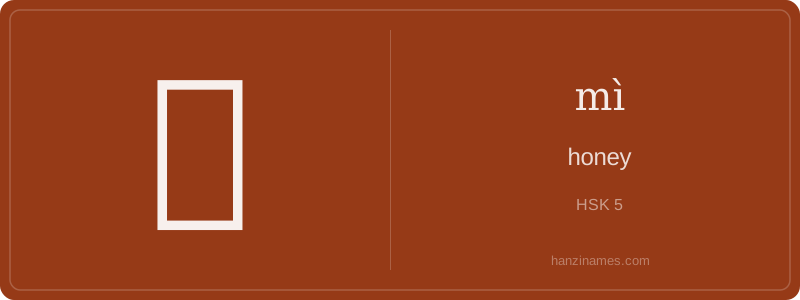
Historically documented since the Warring States period (475–221 BCE), 蜜 appears in early medical texts like the Shennong Bencao Jing (Divine Farmer’s Materia Medica), where it was prescribed for lung ailments and wound healing. Today, it remains central in traditional Chinese medicine (TCM) formulations and daily language—e.g., in the common phrase ‘甜蜜’ (tiánmì, ‘sweet and honeyed’) describing affectionate relationships or joyful moments.
The character’s structure is phono-semantic: the left side 虫 (insect radical) indicates its connection to bees; the right side 密 (mì, ‘dense, secret’) serves as the phonetic component and subtly reinforces meaning—honey’s viscosity and the ‘closeness’ of intimacy. No oracle-bone form survives, but its seal-script form (c. 3rd c. BCE) already shows this stable composition.
The character 蜜 (mì) embodies a profound cultural reverence for natural sweetness—not merely as flavor, but as life-sustaining nourishment and symbolic blessing. In classical Chinese thought, honey was rare, labor-intensive, and prized for its medicinal properties; thus, 蜜 carries connotations of purity, diligence (via the bee), and quiet abundance. Its association with bees—small yet socially perfect creatures—resonates with Confucian ideals of harmonious contribution to the collective.
Unlike Western individualism, where sweetness often signals indulgence, 蜜 in Chinese idioms and poetry evokes gentle, enduring warmth: ‘蜜糖般的日子’ (honey-sugar-like days) describes peaceful prosperity, not excess. The character’s insect radical (虫) grounds it in the tangible world of nature and agriculture—reminding speakers that even refined sweetness originates from humble, communal labor.
This worldview sees value not in extraction alone, but in symbiotic relationship: bees pollinate flowers; humans steward hives; honey becomes both medicine and metaphor. Thus, 蜜 is never just ‘honey’—it’s a linguistic capsule of ecological awareness, interdependence, and the quiet dignity of small, vital things—a subtle yet persistent thread in China’s agrarian and philosophical heritage.
Example Sentences
Common Compounds
Similar Characters — Don't Mix These Up
Your First Step into Chinese Culture: Get a Chinese Name
Every journey into Chinese begins with a name. Use our free Chinese name generator to create a meaningful, personalized Chinese name that fits you perfectly.
Get My Chinese Name →