衡
Character Story & Explanation
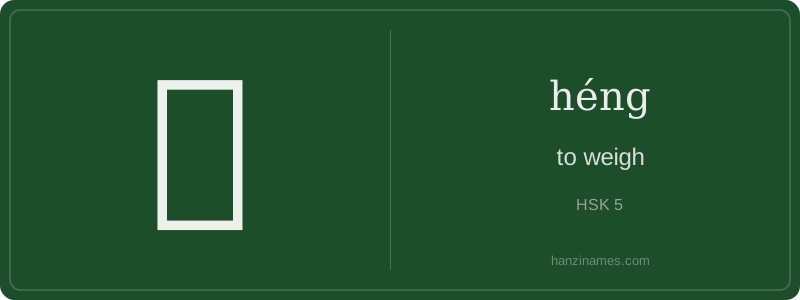
Today, 衡 appears most frequently in formal, institutional, or academic contexts—especially in compounds like 平衡 (píng héng, 'balance'), 衡量 (héng liáng, 'to assess'), and 权衡 (quán héng, 'to weigh pros and cons'). It’s a core HSK 5 vocabulary item, appearing in official documents, economics textbooks, and policy white papers. The idiom '权衡利弊' (quán héng lì bì) — 'weigh advantages and disadvantages' — is ubiquitous in business meetings and media commentary.
The character’s form is not pictographic but phono-semantic: 行 (xíng/háng) serves as the semantic radical (suggesting movement, regulation, or pathway), while 亙 (gèn) provides phonetic approximation. No oracle bone or bronze script forms survive; earliest attestation is in Warring States bamboo texts. In daily life, Chinese people use it consciously in deliberative speech—not in casual chat—but when evaluating decisions, ethics, or data.
As an archaeologist brushing dust from a Han dynasty bamboo slip, I find 衡 inscribed not as a mere verb but as a calibrated standard—literally, the crossbar of a balance scale. Its radical 行 (‘to walk’, ‘road’) suggests movement toward equilibrium, while the right side 亙 (gèn) evokes continuity and horizontal extension—like the beam that must remain level to measure truth. This is no abstract concept: early Chinese metrology treated weighing as moral calibration.
The character appears in excavated legal texts from Zhangjiashan (2nd c. BCE), where ‘衡石’ (hèngshí) denoted official stone weights used to verify grain taxes. Here, 衡 wasn’t just ‘to weigh’—it was state-enforced fairness. The 16 strokes encode precision: every dot and hook aligns like calibration marks on a bronze steelyard, reflecting Confucian ideals where ritual, law, and measurement converged.
In Daoist alchemical manuscripts from Mawangdui, 衡 surfaces in cosmological contexts—‘天衡’ (tiānhéng), the ‘Celestial Balance’, describing the equilibrating force between yin and yang. This metaphysical layer reveals how a technical term for weighing evolved into a philosophical keystone: to weigh is to harmonize, to judge is to center, to govern is to maintain dynamic equilibrium—still central to modern Chinese administrative language.
Example Sentences
Common Compounds
Similar Characters — Don't Mix These Up
Your First Step into Chinese Culture: Get a Chinese Name
Every journey into Chinese begins with a name. Use our free Chinese name generator to create a meaningful, personalized Chinese name that fits you perfectly.
Get My Chinese Name →