订
Character Story & Explanation
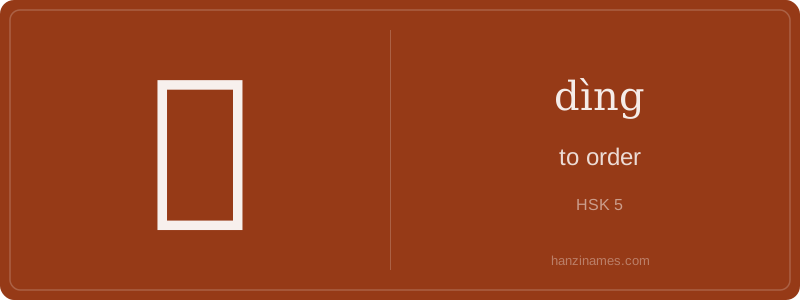
订 is widely used in contemporary China for formal commitments: ordering food via Meituan, booking high-speed rail tickets on 12306, or signing employment contracts. A common phrase is 订婚 (dìng hūn) — 'engagement' — reflecting its historical role in binding familial agreements. The idiom 订立条约 (dìng lì tiáo yuē, 'to conclude a treaty') appears in official documents dating back to the late Qing dynasty and Republic of China era.
The character evolved from seal script, where the right component 丁 resembled a nail — symbolizing 'fixing' or 'securing'. This wasn’t poetic invention: ancient bronze inscriptions show 丁 used for 'nail' or 'peg', and 订 emerged later (Han dynasty onward) to mean 'to fix an agreement in writing', aligning with its modern sense of formalizing verbal commitments.
Hi students! Let’s learn 订 (dìng), a Level 5 HSK character with just four strokes — simple in form, but rich in meaning. It belongs to the ‘speech’ radical 讠, telling us it’s related to language, communication, or agreement. Think of it as the written symbol for making something official through words: signing a contract, placing an order, or confirming plans. Though we translate it loosely as 'to agree', its real-life use is more active and binding — like putting your word into writing.
This character appears everywhere in modern Chinese life: booking train tickets online, subscribing to magazines, or finalizing business deals. It’s not about passive consent; it’s about intentional commitment. You’ll often see it paired with nouns like 订单 (order) or 合同 (contract), reinforcing its role in formalized arrangements. Even children learn it early when ordering lunch at school — it’s practical, not abstract!
Don’t confuse 订 with similar-looking characters like 钉 (nail) or 顶 (top). Its left side 讠 clearly signals speech-based action, while the right side 丁 (dīng) originally represented a nail — suggesting ‘fixing’ or ‘securing’ an agreement, like driving a nail to make something firm and unchangeable. That visual metaphor helps you remember: 订 = spoken commitment made solid.
Example Sentences
Common Compounds
Similar Characters — Don't Mix These Up
Your First Step into Chinese Culture: Get a Chinese Name
Every journey into Chinese begins with a name. Use our free Chinese name generator to create a meaningful, personalized Chinese name that fits you perfectly.
Get My Chinese Name →