询
Character Story & Explanation
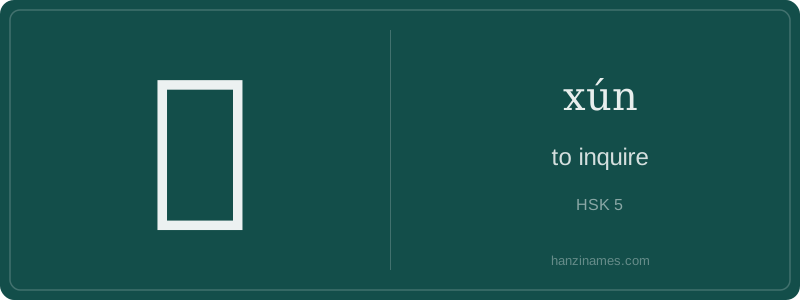
In daily life, 询 appears ubiquitously in official and digital contexts: government service portals (e.g., ‘政策咨询’ — policy consultation), bank KYC forms (‘客户信息询证函’ — client information verification letter), and procurement notices (‘询价函’ — price inquiry letter). It’s central to the standardized phrase ‘咨询电话’ (zīxún diànhuà), meaning ‘information hotline,’ found on every municipal website and hospital sign. Historically, 询 appears in classical texts like the Book of Documents (Shūjīng), where rulers ‘询于众’ (xún yú zhòng) — ‘inquired among the people’ — reflecting early ideals of consultative governance.
The character’s form is not pictographic but phono-semantic: the left side 讠 (yán bàng) indicates speech-related meaning; the right side 寻 (xún) provides both sound and semantic reinforcement — 寻 itself means ‘to search,’ making 询 literally ‘to search via speech.’ No oracle bone or bronze inscription evidence exists for 询; it emerged later in seal script, fully standardized by the Han dynasty as written language formalized bureaucratic communication.
The character 询 (xún) embodies the fundamental human act of seeking information — not casually, but with purpose and respect. Its left radical 讠 (speech radical) signals that this is a verbal, communicative action, while the right component 寻 (xún, 'to search') reinforces the idea of active inquiry. In modern usage, 询 carries a formal, deliberate tone — it’s not ‘hey, what’s up?’ but rather ‘I respectfully seek your expertise.’ This nuance makes it essential in professional, administrative, and academic contexts across China.
Unlike casual verbs like 问 (wèn), which covers everyday questioning, 询 implies structured, often official or procedural investigation. You’ll see it on government service websites, in tender documents, and during customer due diligence — always signaling seriousness and institutional legitimacy. Its eight-stroke structure is compact yet balanced: the speech radical anchors meaning, while 寻 adds semantic depth rooted in classical Chinese, where ‘searching for truth through dialogue’ was a Confucian ideal.
As an HSK Level 5 character, 询 reflects a shift from basic communication to socially nuanced language competence. Learners encounter it when navigating real-world systems — applying for visas, checking policy eligibility, or verifying business credentials. Mastery means understanding not just ‘to ask,’ but *how* and *why* Chinese institutions formalize inquiry: as a step toward transparency, accountability, and informed decision-making — values deeply embedded in both contemporary governance and classical textual traditions like the Zuo Zhuan.
Example Sentences
Common Compounds
Similar Characters — Don't Mix These Up
Your First Step into Chinese Culture: Get a Chinese Name
Every journey into Chinese begins with a name. Use our free Chinese name generator to create a meaningful, personalized Chinese name that fits you perfectly.
Get My Chinese Name →