谨
Character Story & Explanation
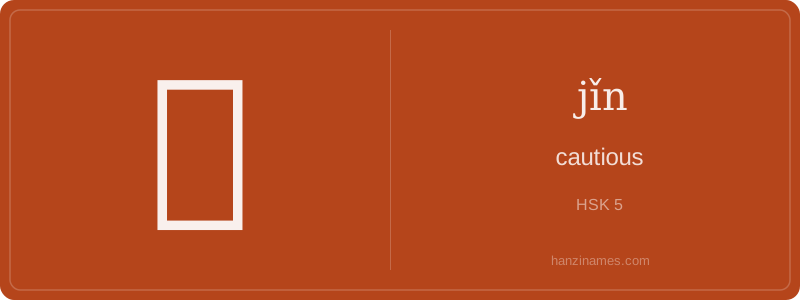
In modern Chinese, 谨 is most commonly seen in formal, respectful contexts: official letters begin with ‘谨启’ (jǐn qǐ, 'respectfully submitted'), academic papers close with ‘谨致谢意’ (jǐn zhì xièyì, 'expressing sincere gratitude'), and public notices use ‘谨防’ (jǐn fáng, 'beware of') for fraud warnings. It appears in the classical idiom ‘谨言慎行’ (jǐn yán shèn xíng, 'speak cautiously, act prudently'), cited in both the *Book of Rites* and contemporary leadership training.
The character’s form is not pictographic but phono-semantic: the 讠 radical indicates speech-related meaning, while the right side 訊 (xùn) serves as both phonetic clue and semantic anchor—‘讯’ means ‘to question’ or ‘to inquire’, underscoring that caution arises from disciplined inquiry, not passive hesitation.
As an archaeologist brushing dust from a Han dynasty bamboo slip, I find 谨 inscribed in elegant clerical script—not as a warning, but as a quiet virtue etched into administrative records. Its left side, 讠 (speech radical), signals that caution here is expressed through words: measured speech, restrained promises, deliberate declarations. This isn’t fear—it’s ethical precision.
Peeling back layers to the Warring States period, I uncover 谨 in philosophical texts like the *Xunzi*, where it describes the cultivated person who ‘speaks only after reflection’—a moral guardrail against rashness. The right component, 訊 (xùn), originally meant ‘to inquire thoroughly’, reinforcing that true caution involves active, respectful investigation before action or utterance.
Unlike characters born of pictorial clarity (like 日 or 山), 谨 emerged from semantic compounding—a linguistic artifact of Confucian statecraft. Its 13 strokes encode not visual metaphor, but procedural discipline: each stroke a step in the ritual of thoughtful engagement. To write it is to rehearse restraint; to read it is to encounter millennia of bureaucratic and scholarly self-regulation.
Example Sentences
Common Compounds
Similar Characters — Don't Mix These Up
Your First Step into Chinese Culture: Get a Chinese Name
Every journey into Chinese begins with a name. Use our free Chinese name generator to create a meaningful, personalized Chinese name that fits you perfectly.
Get My Chinese Name →