豪
Character Story & Explanation
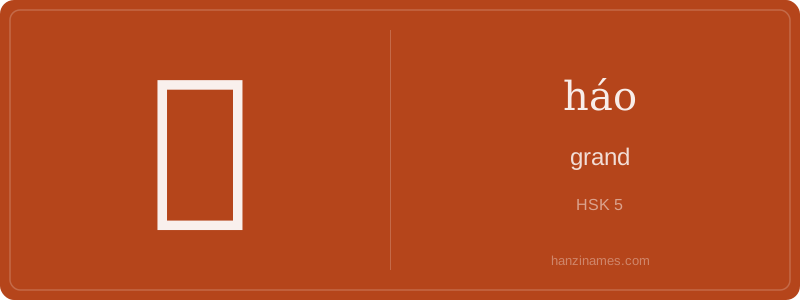
In modern Chinese, 豪 most commonly appears in compound words expressing scale, confidence, or elite status—e.g., 豪华 (háohuá, ‘luxurious’), 豪气 (háoqì, ‘heroic spirit’), and 豪车 (háochē, ‘luxury car’). It’s frequent in advertising (豪装 ‘premium renovation’) and political discourse (豪情壮志 ‘grand aspirations’). A well-documented idiom is 豪言壮语 (háoyán zhuàngyǔ), meaning ‘boastful or heroic declarations’, cited in 20th-century revolutionary literature and CCP historical documents.
The character’s form derives from seal script (c. 3rd c. BCE), where the top component resembles a roof (宀) over mouth (口) and ‘cover’ (冖), combined with 豕 (pig)—a symbol of wealth in early agrarian society. This reflects its original meaning: a powerful, well-provisioned household. No oracle bone form survives; earliest attestation is in Warring States bamboo texts.
As an archaeologist brushing dust from a Han dynasty bamboo slip, I find 豪 inscribed not as a mere adjective—but as a social marker. Its radical 豕 (pig) hints at ancient wealth: livestock were the original capital in agrarian China. The upper part, 亠+口+冖+豕, evolved from seal script forms denoting 'dominant household'—not just grandeur, but inherited status, boldness rooted in material security.
This character’s semantic core emerged during the Warring States period, where ‘háo’ described aristocratic clans with private armies and fortified manors. It wasn’t abstract ‘grandness’—it was measurable: landholdings, retainers, ancestral halls. Later, in Tang poetry, it softened into literary bravado—Li Bai’s ‘豪放’ (unrestrained brilliance)—but never lost its connotation of formidable presence, whether moral, rhetorical, or material.
Excavations of Mawangdui texts confirm 豪 appears in legal documents specifying tax exemptions for ‘háo families’—those exempt from corvée labor due to their regional influence. Thus, 豪 is less ‘magnificent’ and more ‘authoritative at scale’: a sociolinguistic fossil encoding pre-imperial power structures, later repurposed for moral courage (e.g., 豪杰, ‘heroic figure’) and stylistic force (e.g., 豪迈, ‘magnanimous vigor’).
Example Sentences
Common Compounds
Similar Characters — Don't Mix These Up
Your First Step into Chinese Culture: Get a Chinese Name
Every journey into Chinese begins with a name. Use our free Chinese name generator to create a meaningful, personalized Chinese name that fits you perfectly.
Get My Chinese Name →