豫
Character Story & Explanation
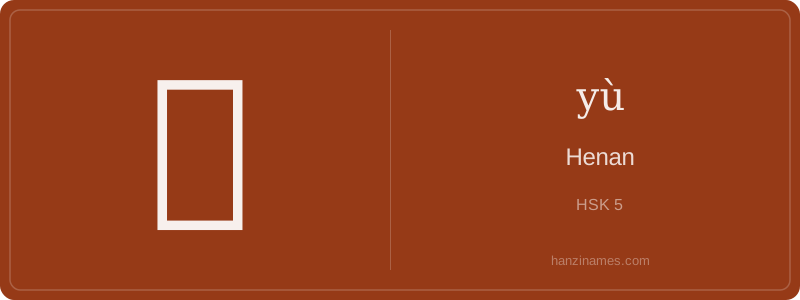
豫 is most commonly used today as the official abbreviation for Henan Province — appearing on vehicle license plates (e.g., 豫A), government documents, and regional branding like ‘豫菜’ (Yù cuisine). Historically, it was the name of the ancient Yuzhou prefecture, one of the Nine Provinces in the Yu Gong (Tribute of Yu), a chapter of the Book of Documents (c. 5th century BCE). The idiom 犹豫不决 (yóu yù bù jué) — literally ‘Yu and You indecisive’ — derives from ancient divination practices involving two animals (a tiger and a turtle), later conflated with the homophone 豫.
The character’s form has no pictographic origin tied to ‘pig’ alone; 豕 (shǐ) is its semantic radical indicating animal-related connotations, while the phonetic component 午 (wǔ) originally signaled pronunciation. Modern scholars agree its shape evolved through seal script standardization, not oracle-bone depiction. Today, Chinese people most often encounter 豫 on highway signs entering Henan or in phrases like ‘出豫入沪’ (leaving Henan for Shanghai).
Imagine standing in Zhengzhou’s bustling Erqi Square, where a bronze plaque reads ‘中原豫州’ — ‘Central Plains, Yuzhou’. Here, 豫 (yù) isn’t just a character; it’s the ancient name for modern Henan Province, one of China’s oldest cultural cradles. The radical 豕 (shǐ), meaning ‘pig’, reflects its earliest association with fertile, livestock-rich lands — a nod to Henan’s agrarian roots and strategic centrality in early Chinese civilization.
Though 豫 now primarily denotes Henan, its classical usage extended to meanings like ‘to hesitate’ or ‘to anticipate’, preserved in idioms like 犹豫不决 (yóu yù bù jué, ‘indecisive’). This semantic duality reveals how geography and psychology intertwine in Chinese script: the land’s abundance fostered both stability and thoughtful deliberation — hence ‘Yù’ as both place and mindset.
In daily life, 豫 appears on license plates (豫A for Zhengzhou), news headlines (‘豫见美好’ — ‘Yù meets beauty’, a provincial tourism slogan), and historical markers at sites like the Yin Ruins in Anyang. It anchors identity — when a Henan native says ‘我是豫人’, they invoke millennia of dynastic capitals, Confucian academies, and the birthplace of oracle bone script, all encoded in those 15 strokes.
Example Sentences
Common Compounds
Similar Characters — Don't Mix These Up
Your First Step into Chinese Culture: Get a Chinese Name
Every journey into Chinese begins with a name. Use our free Chinese name generator to create a meaningful, personalized Chinese name that fits you perfectly.
Get My Chinese Name →