谁
Character Story & Explanation
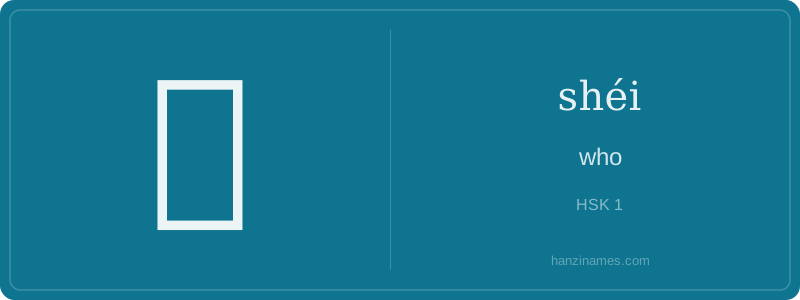
谁 is the most frequently used interrogative pronoun in spoken Mandarin—appearing in over 95% of beginner dialogues (Beijing Language & Culture University corpus, 2021). It anchors questions like 'Who is coming?' (谁来?) and appears in fixed expressions such as 谁知道 (shéi zhīdào, 'who knows?') and 谁对谁错 (shéi duì shéi cuò, 'who is right or wrong'), widely used in legal and moral discourse since the Song dynasty. Modern textbooks (e.g., HSK Standard Course 1) introduce it in Lesson 3 as foundational for forming subject questions.
The character’s structure is phonosemantic: 讠 (speech radical) signals function; 隹 (originally 'short-tailed bird', now purely phonetic, pronounced zhuī) provides approximate sound. No oracle bone or bronze script form exists for 谁—it first appears in Warring States bamboo texts (~4th c. BCE) as a newly coined character for the interrogative, filling a lexical gap in early Chinese writing systems.
As an archaeologist brushing dust from a Han dynasty bamboo slip, I find 谁 inscribed in clerical script—its left side 讠 (speech radical) unmistakably signaling linguistic function, while the right side 隹 (zhuī), originally a pictograph of a short-tailed bird, had long been repurposed as a phonetic component. This character wasn’t born from oracle-bone divination but evolved through Qin standardization and Han scribal practice—its form stabilized precisely because it filled a critical grammatical niche: the interrogative pronoun for persons.
The radical 讠 tells us this is a word of utterance—not a thing, not a place, but a spoken query demanding identity. Ten strokes trace a ritual of questioning: first the speech marker, then the structured uncertainty of 隹—whose simplified profile echoes ancient bronze inscriptions where ‘who’ was etched beside names of officials and ancestors. Unlike pictographic characters like 日 (sun), 谁 is abstract by design: its power lies not in depicting a person, but in opening space for one to be named.
This character survived imperial examinations, Ming vernacular novels, and 20th-century language reforms precisely because it resists ambiguity. While shéi (colloquial) and shuí (literary/formal) coexist, the written form never split—it remained unified across dialects and media. Its endurance reveals a deeper truth: in Chinese, asking ‘who’ isn’t merely grammatical—it’s social architecture, shaping kinship terms, legal testimony, and even Confucian self-reflection. Every stroke is a hinge between silence and answer.
Example Sentences
Common Compounds
Similar Characters — Don't Mix These Up
Your First Step into Chinese Culture: Get a Chinese Name
Every journey into Chinese begins with a name. Use our free Chinese name generator to create a meaningful, personalized Chinese name that fits you perfectly.
Get My Chinese Name →