跃
Character Story & Explanation
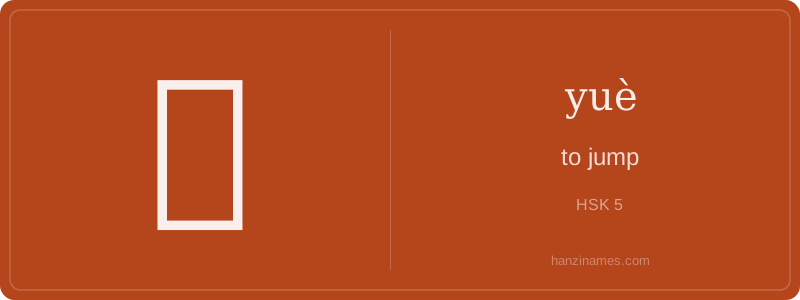
跃 is widely used in contemporary Chinese media and policy discourse, especially in economic and technological contexts. It appears in official reports (e.g., 'digital economy leaps forward'), news headlines (‘5G adoption leaps’), and standardized testing (HSK 5). A well-documented idiom is 龙腾虎跃 (lóng téng hǔ yuè), meaning 'dragons soaring, tigers leaping' — symbolizing vibrant energy and prosperity, frequently invoked during Spring Festival galas and national celebrations since at least the Ming dynasty.
The character evolved from seal script (c. 3rd century BCE), where it clearly combined 足 (foot radical, indicating motion) with 変 (a variant of 拚, suggesting vigorous action). By the Han dynasty, its form stabilized into the modern structure. No oracle bone inscription survives for 跃 — it first appears reliably in bronze inscriptions and early clerical script, confirming its origin as a compound ideograph for energetic, leg-driven movement.
The Chinese character 跃 (yuè) conveys dynamic, upward motion — not just physical leaping, but metaphorical breakthroughs: economic growth 'leaping forward', ideas 'springing to mind', or ambitions 'soaring'. Unlike English 'jump', which often implies transience or playfulness, 跃 carries a tone of purposeful, energetic advancement. It appears in formal and literary contexts more than casual speech, reflecting Confucian and modern socialist ideals of progress through disciplined effort.
In Western equivalents, 'leap' (e.g., 'leap of faith') comes closest in gravitas and metaphorical weight — think Kierkegaard or JFK’s 'moon shot' rhetoric. Yet 'leap' lacks the consistent association with collective advancement found in Chinese usage. Meanwhile, 'bound' or 'vault' emphasize athleticism; 'surge' emphasizes momentum — but none embed institutional aspiration as deeply as 跃 does in phrases like 经济飞跃 (economic leap forward).
Culturally, 跃 resonates with China’s developmental ethos: it’s the verb behind national slogans ('leap forward' during the Great Leap Forward era) and modern tech narratives ('quantum leap' in AI policy docs). While Western metaphors for progress often rely on linear terms ('march', 'advance'), 跃 insists on discontinuous, transformative motion — echoing Daoist notions of sudden insight and Marxist dialectical 'leaps' in historical development.
Example Sentences
Common Compounds
Similar Characters — Don't Mix These Up
Your First Step into Chinese Culture: Get a Chinese Name
Every journey into Chinese begins with a name. Use our free Chinese name generator to create a meaningful, personalized Chinese name that fits you perfectly.
Get My Chinese Name →