躲
Character Story & Explanation
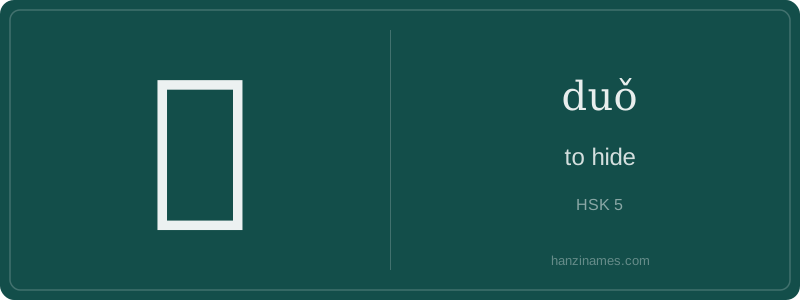
躲 is widely used in modern Mandarin for both literal and figurative avoidance: children 躲雨 (duǒ yǔ, 'dodge rain'), people 躲债 (duǒ zhài, 'evade debt collectors'), and officials accused of misconduct are said to 躲在国外 (duǒ zài guówài, 'hide abroad'). It appears in idioms like 躲得过初一,躲不过十五 (duǒ de guò chū yī, duǒ bù guò shí wǔ)—'you can dodge the 1st, but not the 15th [of lunar month]', meaning temporary evasion won’t prevent inevitable consequences.
The character combines 身 (shēn, 'body') on the left—a radical indicating bodily action—and 叚 (jiǎ, 'false, borrowed') on the right, historically used phonetically. While not pictographic, its structure visually suggests 'the body borrowing concealment'—a documented semantic-phonetic compound from the Shuōwén Jiězì (121 CE), China’s earliest dictionary.
The Chinese character 躲 (duǒ) conveys the core idea of evading or concealing oneself—physically, emotionally, or socially. Unlike English 'hide', which often implies secrecy or play (e.g., hide-and-seek), 躲 carries a stronger nuance of avoidance—sometimes urgent, defensive, or even shame- or stress-driven. It appears in contexts ranging from ducking rain to dodging responsibility, reflecting how Chinese discourse links bodily movement with psychological withdrawal.
Western equivalents like 'duck', 'shrink', 'evade', or 'shy away' capture parts of 躲’s range—but none unify its physical posture (bending the body) and social intention as tightly. In English, we might say 'she hid behind the door' (static concealment), whereas 躲 emphasizes motion *into* cover: '她躲到门后'—literally 'she dodged/withdrew herself behind the door'—highlighting agency and directionality.
This distinction mirrors broader cultural patterns: Chinese communication often values contextual harmony over direct confrontation, making 躲 a pragmatic, sometimes face-saving strategy. In contrast, Western individualism may frame avoidance more negatively—as evasion or cowardice—whereas in Chinese, 躲 can be neutral or even empathetic (e.g., 躲清静 'to seek quiet' reflects self-care, not weakness).
Example Sentences
Common Compounds
Similar Characters — Don't Mix These Up
Your First Step into Chinese Culture: Get a Chinese Name
Every journey into Chinese begins with a name. Use our free Chinese name generator to create a meaningful, personalized Chinese name that fits you perfectly.
Get My Chinese Name →