军
Character Story & Explanation
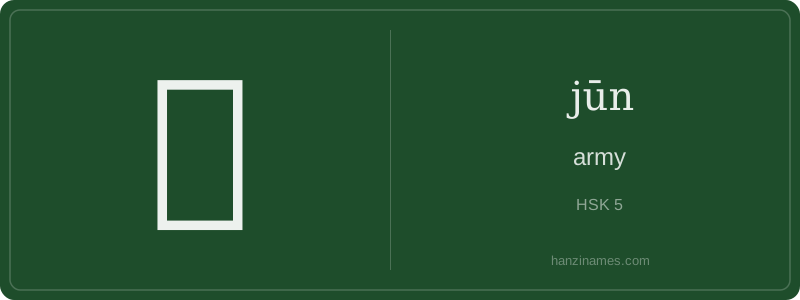
军 is ubiquitous in modern Chinese: from PLA unit names (e.g., 中国人民解放军) to everyday terms like 军训 (military training for students) and 军装 (uniform). It appears in idioms like 破釜沉舟 (‘smash the cooking pots and sink the boats’—a famous military stratagem by Xiang Yu) and official titles (国防部长, Minister of National Defense). Historically, it designated Tang dynasty frontier garrisons (节度使统辖的军) and Ming dynasty guard battalions (卫所制中的军户).
The character’s form derives from seal script (c. 3rd century BCE), where 车 (chariot) + 匀 (a simplified form of 均, ‘to equalize/distribute’) visually represented organized troop deployment around chariots—the core of Zhou and Warring States warfare. No oracle bone form survives; its earliest attested use is on Warring States bamboo texts, confirming its administrative, not pictographic, origin.
As an archaeologist brushing dust from a Warring States bamboo slip, I find 军 etched not as a static symbol but as a living artifact of mobilization—its six strokes encoding the ancient reality of chariot-based warfare. The radical 车 (chē, 'chariot') anchors it in Bronze Age military logistics, while the upper component 匀 (originally a variant of 均, 'even/organized') hints at disciplined troop deployment. This is no mere pictograph of soldiers—it’s a bureaucratic glyph: the state’s power to conscript, organize, and command.
Excavations at Liye Qin slips (221–206 BCE) reveal 军 used routinely in garrison rosters and supply manifests—always paired with numbers, ranks, or locations. Its form stabilized by the Han dynasty, shedding earlier variants with more complex upper elements. Unlike oracle-bone characters for 'war' (e.g., 戈), 军 reflects institutionalized military administration, not battlefield violence—a distinction confirmed by over 300 excavated administrative documents from Shuihudi and Zhangjiashan.
The character’s evolution mirrors China’s shift from feudal levies to professional standing armies. By the Tang dynasty, 军 denoted both elite imperial guard units (e.g., 神策军) and regional garrisons—proving its semantic flexibility within centralized command structures. Even today, its stroke order (starting with the 车 radical’s horizontal stroke) preserves the hierarchical logic: infrastructure (chariot/wheel) before personnel (the organized force above it). This isn’t etymology—it’s epigraphy made legible.
Example Sentences
Common Compounds
Similar Characters — Don't Mix These Up
Your First Step into Chinese Culture: Get a Chinese Name
Every journey into Chinese begins with a name. Use our free Chinese name generator to create a meaningful, personalized Chinese name that fits you perfectly.
Get My Chinese Name →