辞
Character Story & Explanation
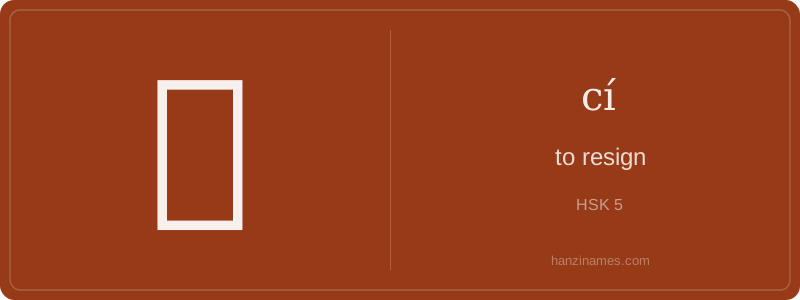
In modern China, 辞 appears most frequently in formal contexts: 辞职 (cízhí, 'to resign') is standard in HR documents, job portals, and workplace announcements. A 2023 Ministry of Human Resources report noted '辞职信' (cízhí xìn, 'letter of resignation') as the third most common official document filed by urban employees. Idiomatically, 危言危行,不辞而别 (wēiyán wēixíng, bù cí ér bié)—'speaking and acting with integrity, yet departing without formal farewell'—criticizes abrupt exits violating relational ethics.
Historically, 辞 evolved from oracle-bone script variants depicting a tongue (舌) beside a 'plea' or 'petition' component. By the Warring States period, it standardized as a semantic-phonetic compound: 舌 (radical, indicating speech-related meaning) + 台 (tái, phonetic, later replaced by 辛 in clerical script). Its structure affirms that resignation is fundamentally rhetorical—a spoken or written act of moral positioning.
The character 辞 (cí) opens a window into the Confucian-infused Chinese worldview where language, duty, and moral integrity are inseparable. Its core meaning—'to resign'—is never merely transactional; it carries weight of ethical withdrawal: stepping down from office not out of failure, but to preserve principle, honor, or harmony. In imperial China, officials submitted formal辞章 (cízhāng, 'resignation memorials') to the emperor—not as rejection of service, but as affirmation of virtue over position.
Radically rooted in 舌 (shé, 'tongue'), 辞 signals that resignation is first an act of speech—a carefully composed, ritually appropriate utterance. This reflects the classical belief that words shape reality: to 'speak out' (辞) is to enact change in social order. Unlike Western notions of quitting, 辞 implies responsibility in departure—graceful, justified, and linguistically precise.
Even today, 辞 resonates beyond employment: 辞别 (cíbié, 'to take formal leave') marks farewells to elders or teachers, embedding respect in linguistic form. The character thus reveals a culture where leaving is not absence, but presence refined—where saying 'no' or 'farewell' is itself an ethical performance, calibrated by relationship, rank, and ritual propriety.
Example Sentences
Common Compounds
Similar Characters — Don't Mix These Up
Your First Step into Chinese Culture: Get a Chinese Name
Every journey into Chinese begins with a name. Use our free Chinese name generator to create a meaningful, personalized Chinese name that fits you perfectly.
Get My Chinese Name →