锅
Character Story & Explanation
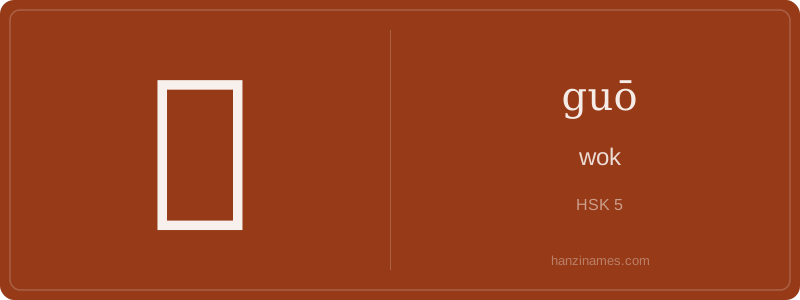
锅 has been central to Chinese domestic and culinary life for over two millennia. Archaeological evidence shows bronze cauldrons (often called 鼎 dǐng, a related term) used in Shang and Zhou dynasties for ritual cooking and storage—later evolving into the iron and steel woks and pots still used today. Modern usage includes common phrases like ‘炒锅’ (chǎo guō, wok for stir-frying) and the popular dish ‘火锅’ (huǒguō, Sichuan-style hotpot), documented in Ming dynasty texts and now globally recognized. The character appears in government food safety standards (e.g., ‘炊具’—cooking utensils) and kitchen appliance labels across China.
The character 锅 is not ancient—it first appeared in regular script during the Tang–Song transition. Its form combines the metal radical 钅 (indicating material) with 国 (guó, 'country') as a phonetic component. While 国 itself means 'country', here it only hints at pronunciation—not meaning. No oracle bone or bronze inscription form exists for 锅; it’s a later, functional invention reflecting the rise of iron cookware.
Hi everyone! Today we’re learning 锅 (guō), a very practical character meaning 'pot', 'pan', or 'wok'. It’s pronounced with the first tone—steady and flat, like saying 'gwoh' while holding your voice high and even. Though it looks complex with 12 strokes, it’s built logically: the left side 钅 (jīn) is the metal radical, telling us this object is made of metal; the right side 国 (guó) gives the sound clue—not perfect, but helpful for memory. This is a classic 'semantic-phonetic compound' structure common in Chinese.
Don’t worry if the stroke order feels tricky at first—just remember the metal radical comes first (3 strokes: ㇀ ㇀ 丿), then the 'country' part 国 (9 strokes, written inside the square frame). Practice writing it slowly while saying 'guō' aloud. Each repetition strengthens both muscle memory and pronunciation. And yes—it’s HSK Level 5, but its everyday usefulness makes it worth mastering early!
Think of 锅 as the heart of Chinese cooking: from stir-frying in a wok to simmering soup in a pot, it’s everywhere in kitchens, recipes, and even slang. You’ll see it in words like 火锅 (huǒguō, hotpot)—a beloved social meal—and even in idioms like '砸锅卖铁' (zā guō mài tiě, 'to sell the wok and iron', meaning to go to extreme lengths to solve a problem). Learning 锅 opens doors not just to vocabulary, but to culture and daily life.
Example Sentences
Common Compounds
Similar Characters — Don't Mix These Up
Your First Step into Chinese Culture: Get a Chinese Name
Every journey into Chinese begins with a name. Use our free Chinese name generator to create a meaningful, personalized Chinese name that fits you perfectly.
Get My Chinese Name →