闲
Character Story & Explanation
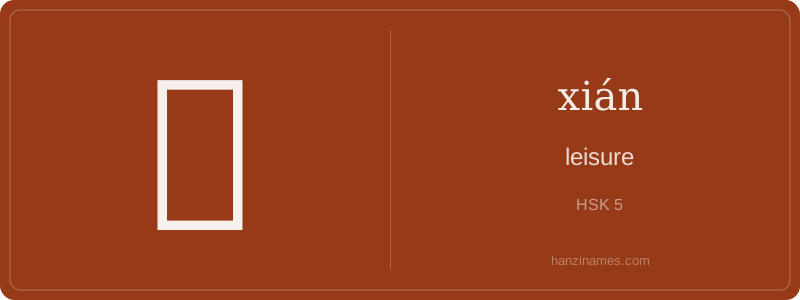
闲 is widely used in daily life — from workplace emails saying ‘我有点闲’ (‘I’m a bit free’) to social media posts like ‘周末闲逛’ (‘leisurely weekend strolling’). A well-documented idiom is 闲言碎语 (xián yán suì yǔ), meaning ‘idle gossip’, listed in authoritative dictionaries like the Xiandai Hanyu Cidian. Historically, 闲 appeared in Tang dynasty poetry describing tranquil gardens — spaces deliberately ‘enclosed’ from worldly bustle.
The character’s form dates to seal script (c. 3rd century BCE), where 门 frames 木 — likely representing a wooden barrier inside a gate, signifying controlled access or reserved space. While not a literal pictograph of a fence, this structure consistently conveyed ‘separation’ or ‘reservation’ across early inscriptions and classical texts.
Hi students! Let’s explore 闲 (xián), a character that looks like a door — and indeed, its radical is 门 (mén), meaning 'gate' or 'door'. At first glance, it might seem like it’s about physical enclosure — and historically, that’s partly true! The top part, 门, frames the bottom part, 木 (mù, 'wood'), suggesting something enclosed within a gate-like structure. But don’t stop there: this character evolved to express abstract enclosures — like time not filled with duties, or space not occupied by people.
In modern Chinese, 闲 rarely means 'enclosure' literally. Instead, it conveys 'free', 'unoccupied', or 'leisurely' — as in having unclaimed time or space. Think of it as ‘enclosed from obligations’ — your schedule is ‘enclosed’ by nothing, so you’re free! This semantic shift from physical boundary to conceptual openness is common in Chinese characters and shows how language reflects cultural values around rest and balance.
As an HSK Level 5 character, 闲 appears frequently in intermediate-to-advanced contexts — especially in compound words and idioms. It’s not just about idleness; it carries subtle nuance: being ‘at leisure’ implies dignity and choice, not laziness. You’ll see it in phrases like 闲聊 (xiánliáo, 'casual chat') or 闲人 (xiánrén, 'person with free time' — sometimes affectionate, sometimes dismissive!). Mastering 闲 helps you understand not only vocabulary but also Chinese attitudes toward time, work, and well-being.
Example Sentences
Common Compounds
Similar Characters — Don't Mix These Up
Your First Step into Chinese Culture: Get a Chinese Name
Every journey into Chinese begins with a name. Use our free Chinese name generator to create a meaningful, personalized Chinese name that fits you perfectly.
Get My Chinese Name →