闯
Character Story & Explanation
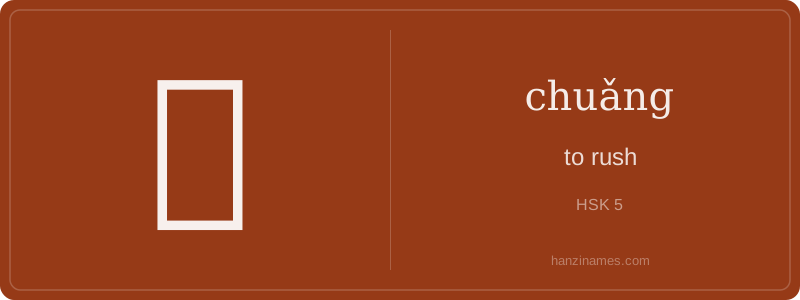
闯 is widely used in modern Chinese for high-energy, boundary-pushing actions—especially in business, media, and youth discourse. The idiom 闯江湖 (chuǎng jiānghú) — literally 'rush into the rivers and lakes' — historically referred to wandering martial artists or itinerant performers navigating unpredictable social terrain; today it means 'to make one’s way in the world', especially through grit and improvisation. Another common phrase is 闯红灯 (chuǎng hóngdēng), 'to run a red light', used both literally and figuratively for rule-breaking.
The character’s form is well-documented: it combines the radical 门 (mén, 'gate') with 马 (mǎ, 'horse')—a phonetic-semantic compound. Though 马 no longer perfectly matches the pronunciation, it signals movement and force. Historically, 闯 appeared in Ming-Qing vernacular texts (e.g., *Water Margin*) to describe rebels bursting through gates—a usage grounded in real military and social upheaval.
The Chinese character 闯 (chuǎng) conveys dynamic, often bold or impulsive motion—'to rush', 'to burst into', or 'to venture boldly'. Unlike English verbs like 'enter' or 'go', 闯 carries inherent connotations of speed, lack of permission, or boundary-crossing. It’s rarely neutral: entering a room quietly is not 闯; barging in unannounced is. This reflects a cultural sensitivity to social thresholds—physical, institutional, or metaphorical—where initiative must be weighed against decorum.
In Western contexts, equivalents like 'burst in', 'storm into', or 'break into' come closest—but they’re emotionally charged and situational. 'Rush' alone is too generic; 'crash' implies destruction; 'intrude' emphasizes violation over energy. 闯 uniquely blends agency, velocity, and transgression without automatic moral judgment—making it versatile in both criticism ('he rushed into politics') and praise ('she broke into the international market').
This duality mirrors broader Chinese linguistic patterns where action verbs embed evaluative nuance. Compare 'to open a business' (创业 chuàngyè) versus 'to rush into business' (闯入商界 chuǎngrù shāngjiè): the latter suggests risk, haste, or outsider status. In cross-cultural communication, misreading 闯 as merely 'enter' can obscure intent—e.g., describing a startup’s growth as 闯市场 may signal disruptive ambition, not just market entry.
Example Sentences
Common Compounds
Similar Characters — Don't Mix These Up
Your First Step into Chinese Culture: Get a Chinese Name
Every journey into Chinese begins with a name. Use our free Chinese name generator to create a meaningful, personalized Chinese name that fits you perfectly.
Get My Chinese Name →