买
Character Story & Explanation
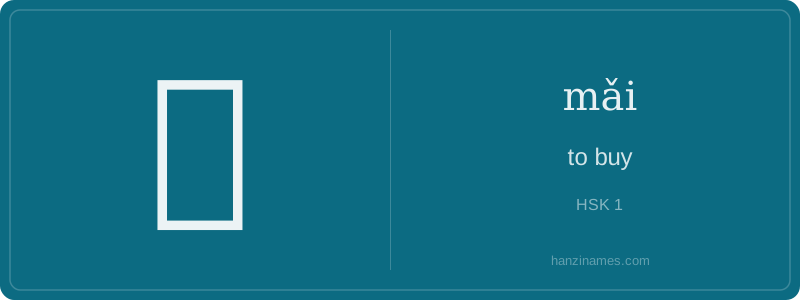
买 is ubiquitous in modern Chinese life: used in supermarkets, e-commerce (Taobao/Alibaba interfaces), public transport (buying subway tickets), and official forms (e.g., visa application fees). It appears in fixed phrases like 买东西 (mǎi dōngxi, 'to buy things') — the most common colloquial expression for shopping — and in the idiom 买椟还珠 (mǎi dú huán zhū, 'buying the box and returning the pearl'), recorded in the Warring States text *Han Feizi*, criticizing superficial judgment.
The character’s earliest attested form appears in clerical script (Lishu) during the Han Dynasty (~206 BCE–220 CE). It evolved from a combination of 大 (dà, 'big') and 网 (wǎng, 'net'; now simplified to 冖 + 乙), originally representing 'acquiring goods under a market canopy'. No oracle bone or bronze inscriptions contain 买 — its form stabilized only after the Qin standardization of script.
The Chinese character 买 (mǎi) means 'to buy' and is one of the most frequently used verbs in daily Mandarin. As an HSK Level 1 character, it appears early in language learning due to its high utility in shopping, dining, and transactional contexts. Unlike English, where 'buy' implies ownership transfer, 买 carries no inherent connotation of payment method — cash, digital wallet (e.g., WeChat Pay), or even barter — reflecting China’s flexible commercial culture.
Western equivalents like 'purchase' (formal) or 'get' (colloquial) don’t fully map onto 买, which is neutral, versatile, and rarely marked for register. In contrast to English’s verb–preposition combinations (e.g., 'buy into', 'buy off'), 买 remains strictly transactional — no idiomatic extensions beyond commerce. Its simplicity masks cultural nuance: in China, the act of buying often implies relationship-building (e.g., gift-giving as social investment), not just acquisition.
While English speakers may associate 'buying' with individual consumerism, 买 frequently appears in collective or familial contexts — e.g., parents 买 groceries for the household or students 买 group meal tickets. This reflects Confucian-influenced values prioritizing family responsibility over personal consumption. Also, unlike Western retail norms where 'buying' is often detached from bargaining, 买 in informal markets (e.g., street vendors) still commonly co-occurs with negotiation — a practice documented in urban ethnographies across Guangzhou and Chengdu.
Example Sentences
Common Compounds
Similar Characters — Don't Mix These Up
Your First Step into Chinese Culture: Get a Chinese Name
Every journey into Chinese begins with a name. Use our free Chinese name generator to create a meaningful, personalized Chinese name that fits you perfectly.
Get My Chinese Name →