猫
Character Story & Explanation
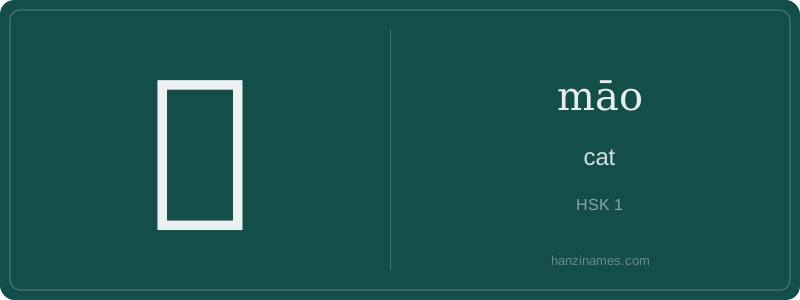
猫 has been part of written Chinese for over 2,000 years — appearing in Han dynasty texts as a domestic animal used for pest control. Today, it’s ubiquitous in daily life: from pet adoption ads and veterinary clinics to viral 'cat memes' on Weibo and Douyin. Common phrases include '小猫' (xiǎo māo, 'kitten') and idioms like '照猫画虎' (zhào māo huà hǔ, 'drawing a tiger by copying a cat' — meaning imitating superficially without understanding).
The character is not a pictograph but a phono-semantic compound: 犭 (quǎn, 'dog/beast' radical) conveys category, while 者 was historically used for phonetic approximation. Though its oracle-bone or bronze script origins are unattested for 猫 specifically, the earliest reliable forms appear in seal script (c. 3rd century BCE), already showing the familiar two-part structure.
Hello, learners! The character 猫 (māo) means 'cat' — a beloved pet and cultural symbol in China. It’s an HSK Level 1 character, so you’ll encounter it very early in your studies. With just 11 strokes and the ‘dog’ radical (犭), it signals this is an animal-related word. Don’t worry about memorizing all strokes at once — focus first on recognizing its shape and sound. Practice saying 'māo' with a flat, high tone (like singing a steady note), as tone errors can change meaning entirely.
Notice how the left side 犭 (the 'dog' or 'beast' radical) appears in many animal characters — like 狗 (gǒu, dog) and 狼 (láng, wolf). This helps you group vocabulary logically. The right side, 者 (zhě), is a phonetic component that hints at pronunciation (though modern 'māo' doesn’t sound like 'zhě', this reflects historical sound shifts). That’s common in Chinese: radicals give meaning clues, phonetics give rough sound hints.
As a beginner, use 猫 to build simple, real-life sentences: 'I have a cat', 'The cat is black', or even 'I like cats'. It’s also fun to learn playful expressions — like '懒猫' (lǎn māo, 'lazy cat') for someone dozing off. Since cats are popular pets in urban China and appear often in social media, cartoons, and internet slang (e.g., '吸猫' — xī māo, 'cat-sucking', meaning 'obsessively watching cat videos'), this character opens doors to authentic, modern language use.
Example Sentences
Common Compounds
Similar Characters — Don't Mix These Up
Your First Step into Chinese Culture: Get a Chinese Name
Every journey into Chinese begins with a name. Use our free Chinese name generator to create a meaningful, personalized Chinese name that fits you perfectly.
Get My Chinese Name →