集
Character Story & Explanation
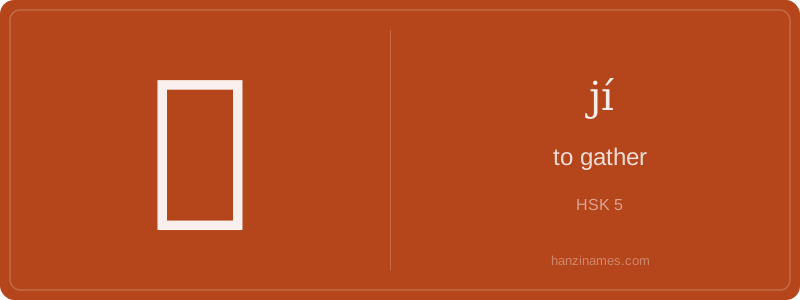
集 appears in daily life across contexts: academic journals (学报, xuébào) are called ‘jí’ (e.g., 《中国语文集》); markets are 集市 (jíshì), historically weekly rural gatherings documented since the Song Dynasty (960–1279). The idiom 集思广益 (jísī guǎngyì) — ‘gather thoughts to broaden benefits’ — has been used in official documents since the Three Kingdoms period (3rd c. CE), cited in the Records of the Three Kingdoms. It remains standard in corporate and policy meetings today.
Archaeologically, 集 first appears in bronze inscriptions of the late Zhou Dynasty (c. 5th c. BCE) as a compound of 隹 (bird) + 木 (tree), picturing birds gathering on a branch — a well-documented early form confirmed by Shāndōng Provincial Museum analyses of Warring States bronzes. This visual origin remains legible in the modern character’s structure.
The character 集 (jí) embodies a foundational Chinese worldview: harmony through convergence—not domination, but coalescence. Unlike Western notions of ‘collection’ that may emphasize ownership or classification, 集 evokes organic assembly—birds alighting on a branch, ideas crystallizing in dialogue, people gathering for ritual or resistance. This reflects Confucian and Daoist values where unity arises from mutual resonance, not hierarchy.
Its radical 隹 (zhuī), meaning ‘short-tailed bird’, anchors the concept in nature: birds flocking instinctively symbolize spontaneous order and collective wisdom. In classical texts, 集 often describes scholars compiling texts or officials assembling at court—not as subordinates, but as contributors to a shared cultural body. Gathering is thus an ethical act, affirming relational identity over isolated selfhood.
This worldview persists today: from community-based disaster relief to collaborative digital platforms like Bilibili (where users ‘collect’ knowledge via bullet-screen comments), 集 signals participatory cohesion. Even in modern governance, terms like ‘集思广益’ (jísī guǎngyì, ‘gather ideas to broaden benefits’) echo ancient statecraft ideals—wisdom resides not in one sage, but in the gathered many. To gather is to cultivate harmony; to disperse, to risk fragmentation.
Example Sentences
Common Compounds
Similar Characters — Don't Mix These Up
Your First Step into Chinese Culture: Get a Chinese Name
Every journey into Chinese begins with a name. Use our free Chinese name generator to create a meaningful, personalized Chinese name that fits you perfectly.
Get My Chinese Name →