霉
Character Story & Explanation
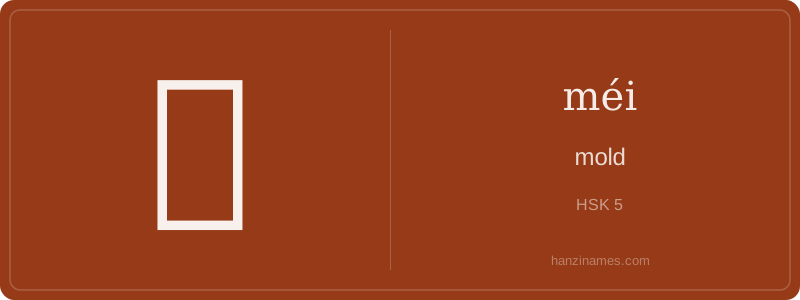
In daily life, 霉 is commonly used in compound words related to spoilage and misfortune. The idiom 倒霉 (dǎoméi, 'bad luck') appears in Ming-dynasty vernacular literature, such as the 16th-century novel Jin Ping Mei, where it describes sudden reversals of fortune—linking physical decay with social vulnerability. Modern speakers say 这面包发霉了 (zhè bāozi fā méi le, 'This steamed bun has molded') or 房间太潮,容易发霉 (fángjiān tài cháo, róngyì fā méi, 'The room is too damp—mold grows easily').
The character’s form is not pictographic but phono-semantic: the top 雨 (rain) is the semantic component indicating environmental causation; the bottom 每 (měi, originally meaning 'every' or 'repeatedly') serves as the phonetic cue. Though 每 now reads měi, historical sound shifts explain its use for méi. No oracle-bone or bronze inscriptions of 霉 survive—it first appears reliably in Song-era texts describing food spoilage and damp-related ailments.
The character 霉 (méi) embodies a subtle yet profound aspect of the Chinese worldview: the interplay between environment, time, and impermanence. Its radical 雨 (yǔ, 'rain') signals that mold arises not from inherent flaw, but from external conditions—dampness, stagnation, lack of airflow—reflecting the classical Daoist and medical belief that health and harmony depend on balanced qi and environmental harmony.
Unlike Western notions that often frame mold as purely pathological or contaminating, traditional Chinese thought sees 霉 as a natural consequence of imbalance—not moral failure, but a diagnostic sign. In Traditional Chinese Medicine (TCM), ‘dampness’ (湿, shī) is a pathogenic factor closely linked to moldy environments; thus, 霉 evokes both physical decay and metaphoric stagnation in fortune or spirit.
This duality extends into language: while 霉 literally means ‘mold’, it also forms expressions like 倒霉 (dǎoméi, ‘bad luck’) — where ‘falling into mold’ metaphorically suggests being overtaken by unseen, dampening forces. Such usage reveals a cultural sensitivity to invisible, accumulative influences — a worldview where fate, hygiene, and atmosphere are linguistically and philosophically entwined.
Example Sentences
Common Compounds
Similar Characters — Don't Mix These Up
Your First Step into Chinese Culture: Get a Chinese Name
Every journey into Chinese begins with a name. Use our free Chinese name generator to create a meaningful, personalized Chinese name that fits you perfectly.
Get My Chinese Name →