革
Character Story & Explanation
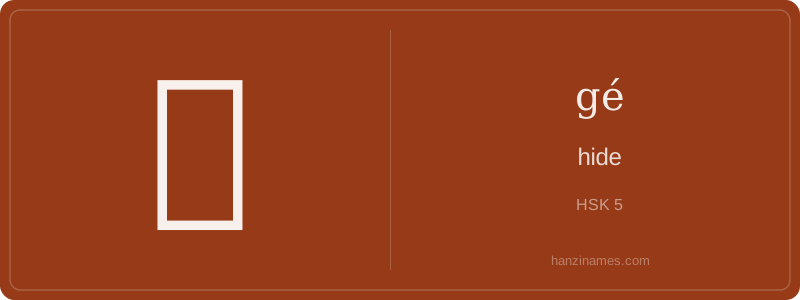
In daily life, 革 appears most frequently in compound words related to reform (改革 gǎigé), revolution (革命 gémìng), and leather goods (皮革 pígé). It is central to modern political vocabulary: the Communist Party’s official name includes ‘revolution’ (革命), and ‘reform and opening-up’ (改革开放 gǎigé kāfàng) shaped China’s economic transformation since 1978. Idiomatically, 革故鼎新 (gégù dǐngxīn, ‘discard the old, establish the new’) is cited in policy documents and editorial writing.
The character’s earliest attested form is in Warring States bamboo slips and Han dynasty seals, where it consistently depicts processed hide—not raw skin—confirmed by excavated leather armor fragments from Mawangdui Tomb (2nd c. BCE). Its structure reflects practical tanning: the top and bottom strokes represent the stretched edges; the inner ‘ten’ shape mirrors the grid-like fiber alignment visible under magnification in ancient Chinese leather samples.
Our detective work begins with the oracle bone and bronze inscriptions—though 革 does not appear in earliest oracle bones, it emerges clearly in late Shang and Zhou bronze script as a stylized depiction of a stretched animal hide, often with visible hair follicles or grain patterns. Early forms show two parallel lines (representing the tanned surface) flanked by curved strokes suggesting folded or draped leather—a functional, tactile image rooted in ancient craftsmanship.
By the Qin and Han dynasties, the seal script standardizes the structure: top and bottom horizontal strokes frame a central ‘ten’-shaped component (十), now interpreted as a schematic cross-section of hide with its fibrous layers. The radical itself doubles as both meaning carrier and independent character—rare among radicals—signifying that 革 was so foundational to material culture (armor, drums, writing surfaces) that it needed no semantic modifier.
Modern regular script preserves this layered logic: the nine strokes encode history in motion—starting with a dot (hair or grain), descending stroke (hide’s edge), then interlocking horizontal and vertical lines mimicking the tension of stretched leather. Even today, calligraphers emphasize the ‘press-and-hold’ weight on the final horizontal stroke—echoing the tanner’s act of stretching and securing raw hide on a frame.
Example Sentences
Common Compounds
Similar Characters — Don't Mix These Up
Your First Step into Chinese Culture: Get a Chinese Name
Every journey into Chinese begins with a name. Use our free Chinese name generator to create a meaningful, personalized Chinese name that fits you perfectly.
Get My Chinese Name →