鞭
Character Story & Explanation
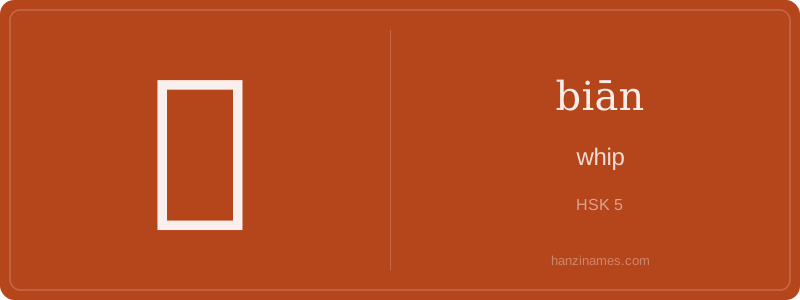
In historical texts like the Records of the Grand Historian, 鞭 appears in contexts of authority and punishment—e.g., officials using a ‘horsewhip’ (马鞭) to signal commands or enforce discipline. Modern usage centers on idioms like 鞭长莫及 (biān cháng mò jí, 'the whip is too long to reach')—a metaphor for powerlessness over distant affairs, famously cited in diplomatic discourse since the Qing dynasty. It also survives in martial arts terminology (e.g., 鞭法, biān fǎ, 'whip technique') and equestrian culture.
The character is not pictographic—it emerged later, during the seal script era (c. 3rd century BCE), combining 革 (leather) with 便 (phonetic). No oracle bone or bronze forms exist for 鞭; its earliest confirmed form is in Qin bamboo slips. Today, Chinese learners encounter it most often in HSK 5 reading passages about history, governance, or classical idioms—not in daily conversation, but in formal writing and exams.
Our detective begins at the crime scene: the character 鞭 (biān), an 18-stroke compound under the 'leather' radical 革. The left side, 革, signals material—historically, whips were made from cured animal hide. This isn’t decorative; it’s functional etymology: a whip *is* leather, transformed into instrument. The right side, 便 (biàn), is phonetic—but not perfectly. In Old Chinese, 便 and 鞭 shared closer pronunciation (*bren* or *bran*), revealing how sound-shifting over millennia cracked the phonetic code.
Zooming in, we notice 便 itself contains 亻(person) + 更 (to change)—hinting at human agency in tool-making. So 鞭 subtly encodes *a person crafting a flexible, controlled instrument from leather*. No oracle-bone depictions survive for 鞭, but bronze inscriptions from the Warring States period (475–221 BCE) confirm its use in military command and ritual discipline—whips weren’t just for horses, but for enforcing order among troops and servants.
Our final clue lies in stroke logic: the 18 strokes flow deliberately—first the leather base (革), then the phonetic scaffold (便). Every horizontal, dot, and hook follows classical calligraphic rules for balance and force—mirroring how a real whip must be both supple and precise. Even today, writing 鞭 slowly trains the hand to embody control: no rushed strokes, no slack lines—just like wielding the object itself.
Example Sentences
Common Compounds
Similar Characters — Don't Mix These Up
Your First Step into Chinese Culture: Get a Chinese Name
Every journey into Chinese begins with a name. Use our free Chinese name generator to create a meaningful, personalized Chinese name that fits you perfectly.
Get My Chinese Name →