顿
Character Story & Explanation
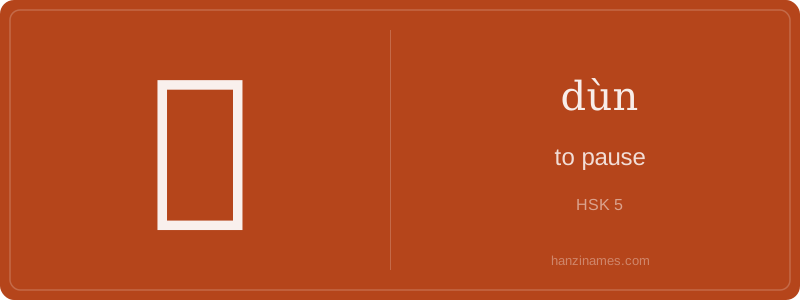
Historically, 顿 appears in pre-Qin bronze inscriptions and the Shuōwén Jiězì (121 CE), defined as ‘to bow the head’ (以首叩地), later extended to ‘pause’ or ‘halt’. It’s central in idioms like 顿开茅塞 (dùn kāi máo sè, ‘suddenly enlightened’, lit. ‘the thatched block bursts open’), reflecting the cultural link between stopping and insight. In daily use, it’s common in verbs like 顿悟 (sudden realization) and phrases like 一顿饭 (a meal—lit. ‘a stop of food’, implying measured, complete servings).
The character’s form combines 页 (yè, ‘head/face’, radical) and 屯 (tún, ‘to gather/encamp’, phonetic and semantic component). 屯 originally depicted sprouting seeds—a symbol of potential energy held in reserve. Thus, 顿 visually encodes ‘a head-held pause’ where readiness and restraint coexist—no invention, just documented structure from Shuōwén.
The character 顿 (dùn) embodies a subtle yet profound aspect of the Chinese worldview: the reverence for intentional pause. Unlike Western notions of stopping as interruption or failure, 顿 signifies a purposeful, often respectful cessation—like bowing before speaking, pausing mid-sentence to gather thought, or halting movement to honor hierarchy or ritual. This reflects Confucian ideals where timing, restraint, and situational awareness are moral virtues—not mere logistics.
In classical texts, 顿 appears in contexts demanding mindful stillness: a general halting troops before battle, a scholar pausing before reciting poetry, or a disciple bowing deeply (顿首 dùnshǒu) to show deference. Such pauses are not empty gaps but charged moments of alignment—with tradition, with others, with cosmic order (li 理). The ‘stop’ is thus generative, not inert.
This philosophy permeates modern life: a teacher may 顿一下 (dùn yíxià)—‘pause briefly’—to let students absorb a point; a calligrapher lifts the brush in deliberate 顿笔 (dùnbǐ) before the next stroke. Even in digital communication, ‘我顿一下’ (‘I’ll pause a sec’) signals thoughtful engagement, not disengagement. To stop, in this frame, is to attune—to self, to others, to meaning itself.
Example Sentences
Common Compounds
Similar Characters — Don't Mix These Up
Your First Step into Chinese Culture: Get a Chinese Name
Every journey into Chinese begins with a name. Use our free Chinese name generator to create a meaningful, personalized Chinese name that fits you perfectly.
Get My Chinese Name →