领
Character Story & Explanation
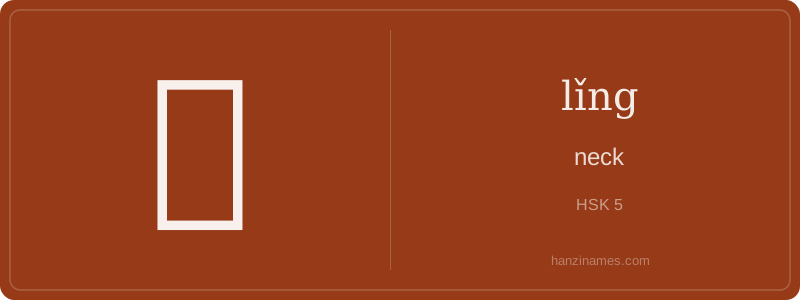
Historically, 领 appears in the Shuōwén Jiězì as a character with the 页 radical and a phonetic component 令 (lìng), indicating pronunciation. It was used in pre-Qin bronze inscriptions and Han dynasty texts to mean 'neck'—e.g., in the phrase '领如蝤蛴' (lǐng rú qiúqí, 'neck like a white grub') from the Book of Songs, praising graceful necks. Today, it’s most common in bureaucratic and organizational contexts: 领导 (lǐngdǎo, 'leader'), 领取 (lǐngqǔ, 'to collect'), and 领域 (lǐngyù, 'field/domain').
The character’s form evolved from a pictograph of a person’s head and neck (oracle bone script variants show a head with vertical lines suggesting vertebrae), later standardized with the 页 radical for head-related meanings. Though no longer used alone for 'neck' in speech, it survives in clothing terms like 衬衫领 (chènshān lǐng, 'shirt collar')—a tangible, daily-life link to its origin.
The Chinese character 领 (lǐng) originally denoted the 'neck'—a literal anatomical reference—and appears in classical texts like the Shuōwén Jiězì (100 CE), where it is defined as 'the front part of the neck.' Its radical 页 (yè, 'page' or 'leaf') relates to the head/face area in many characters (e.g., 颅 lú 'skull', 额 é 'forehead'), reflecting ancient Chinese categorization by body region rather than function.
Over time, 领 extended metaphorically to 'lead,' 'command,' and 'take charge'—as the neck supports and directs the head, so a leader guides others. This semantic shift parallels English expressions like 'neck of the woods' (region) or 'take the lead,' but differs from Western leadership metaphors rooted in hierarchy (e.g., 'crown,' 'throne')—Chinese usage emphasizes bodily integration and relational responsibility.
In modern Mandarin, 领 rarely means 'neck' in isolation; instead, it appears in compounds like 领带 (lǐngdài, 'tie') and 领导 (lǐngdǎo, 'leadership'). Unlike English, where 'neck' evokes vulnerability (e.g., 'at the neck of the bottle') or informality ('neck and neck'), 领 carries formal, authoritative connotations—highlighting how bodily metaphors in Chinese grammar encode social structure and duty.
Example Sentences
Common Compounds
Similar Characters — Don't Mix These Up
Your First Step into Chinese Culture: Get a Chinese Name
Every journey into Chinese begins with a name. Use our free Chinese name generator to create a meaningful, personalized Chinese name that fits you perfectly.
Get My Chinese Name →