医
Character Story & Explanation
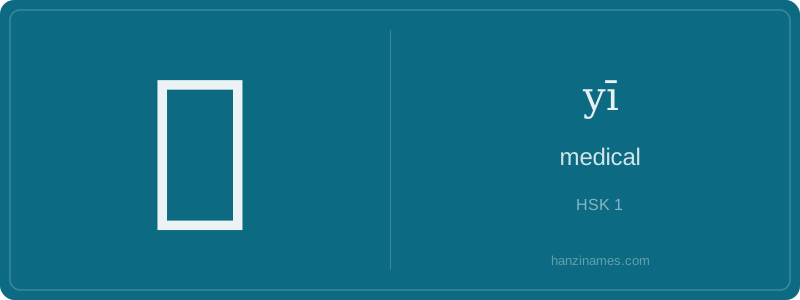
In daily life, 医 appears ubiquitously: on hospital signs (医院 yīyuàn), health insurance cards (医保 yībǎo), and WeChat appointment pages. Historically, it anchors key phrases like 医者仁心 (yī zhě rén xīn)—‘a physician’s heart is benevolent’—a Confucian ideal cited since the Song dynasty in official medical ethics edicts. It also forms the core of the famous idiom 对症下药 (duì zhèng xià yào, ‘prescribe medicine according to symptoms’), first recorded in the 14th-century medical treatise Zhenjiu Dacheng.
The character’s modern form derives from seal script, where the left 匸 enclosure frames 矢 (arrow), likely indicating ‘removing harmful agents’. While earlier bronze inscriptions show variant forms, no oracle bone version of 医 has been confirmed—its earliest secure appearance is on Mawangdui silk medical texts (2nd c. BCE), confirming its association with organized clinical practice, not shamanic ritual.
As an archaeologist brushing dust from a Han dynasty bamboo slip, I find 医 etched not as a divine glyph but as a pragmatic seal—its seven strokes a compact ledger of healing labor. The radical 匸 (xì), meaning 'enclosure' or 'hiding place', frames the inner component 矢 (shǐ, 'arrow'), suggesting containment of harm—perhaps early medicine’s core mission: to shield the body from injury and illness. This isn’t mysticism; it’s functional semantics carved into administrative records of state-run clinics.
The character’s earliest attested form appears in seal script (zhuànshū) on Western Han medical manuscripts from Mawangdui (c. 168 BCE), where 医 consistently modifies terms like ‘physician’ (医者) and ‘medical recipe’ (医方). Crucially, it never appears alone as a verb in classical texts—it functions exclusively as a noun modifier or nominal root, revealing its grammatical role as a classifier of professional practice, not abstract ‘health’.
Unlike ideograms born from pictorial suns or rivers, 医 evolved through bureaucratic standardization—not oracle-bone revelation. Its stability across two millennia reflects imperial investment: by the Tang dynasty, the Ministry of Rites administered the Imperial Medical Bureau (太医署), and every exam-taker knew 医 as the first character in ‘medical officer’ (医官) and ‘pharmacist’ (药师). Its endurance is archaeological evidence of China’s world-first state-sponsored healthcare system.
Example Sentences
Common Compounds
Similar Characters — Don't Mix These Up
Your First Step into Chinese Culture: Get a Chinese Name
Every journey into Chinese begins with a name. Use our free Chinese name generator to create a meaningful, personalized Chinese name that fits you perfectly.
Get My Chinese Name →