显
Character Story & Explanation
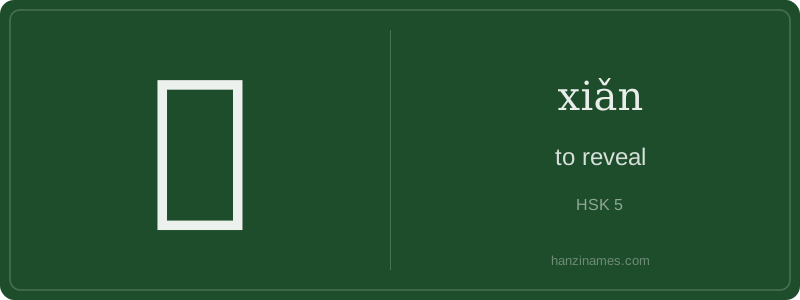
显 is commonly used in modern Chinese to describe observable phenomena — especially in medicine (e.g., 症状明显, 'symptoms are pronounced'), science ('visible evidence'), and media ('a prominent figure'). A well-documented idiom is 显而易见 (xiǎn ér yì jiàn), meaning 'obvious' or 'self-evident', appearing in official documents since at least the early 20th century and included in standard dictionaries like the Xiandai Hanyu Cidian. It’s also frequent in news headlines reporting measurable trends (e.g., 经济回升迹象明显, 'signs of economic recovery are evident').
The character’s form is documented in seal script (c. 3rd century BCE) as a combination of 日 (sun) and 㬎 (an ancient variant of 页, related to 'head' or 'prominence'). Scholars confirm this structure reflects the idea of 'making something stand out like sunlight on a face'. No oracle bone form survives — its earliest attested shape already shows this semantic composition.
Hello students! The character 显 (xiǎn) means 'to make visible' or 'to reveal' — think of turning on a light to see something clearly. It’s not about being inherently visible, but about actively bringing something into view: a truth, a symptom, a sign, or even a person’s status. Though it looks simple, its meaning is powerful and widely used in both formal writing and daily speech — especially when describing things becoming apparent through evidence or effort.
Notice its radical 日 (rì), meaning 'sun' or 'day'. This isn’t coincidental: sunlight makes things visible! So the character visually connects illumination with revelation. Its nine strokes follow a logical order — start with the sun radical on the left, then build the right side (the 'ghost' component 页, simplified from 頁 meaning 'page' or 'head', historically linked to prominence or appearance). Don’t memorize strokes by rote — link them to meaning!
At HSK Level 5, 显 appears in academic, medical, and media contexts — like 显而易见 (obviously evident) or 症状明显 (symptoms are clear). It often pairs with verbs like 出 (to appear) or 得 (to show/manifest), as in 显出 (to reveal) or 显得 (to appear/seem). Remember: 显 is *active* — someone or something *makes* something visible, not just 'is visible'. That nuance matters for natural usage.
Example Sentences
Common Compounds
Similar Characters — Don't Mix These Up
Your First Step into Chinese Culture: Get a Chinese Name
Every journey into Chinese begins with a name. Use our free Chinese name generator to create a meaningful, personalized Chinese name that fits you perfectly.
Get My Chinese Name →