飘
Character Story & Explanation
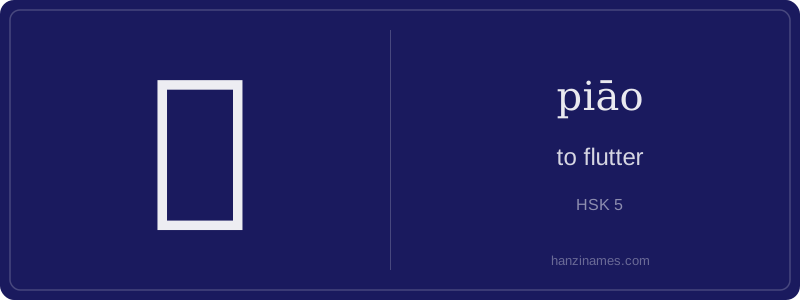
‘Piāo’ appears frequently in modern Mandarin in both literal and figurative contexts: weather reports (‘云朵飘过’), emotional states (‘心飘了’—‘my heart floated away’, i.e., distracted), and economic jargon (‘股价飘红’—‘stock price surged’). It’s central to idioms like ‘飘洋过海’ (piāo yáng guò hǎi, ‘to cross oceans’—used for overseas migration since late Qing/early Republican era) and ‘飘忽不定’ (piāo hū bù dìng, ‘fickle, elusive’), documented in early 20th-century literature including Lu Xun’s essays.
The character evolved from seal script (c. 3rd c. BCE), where the left side was clearly 风 (wind), and the right side was 票 (piào), originally meaning ‘a small flag’—a visual compound indicating ‘wind-blown flag’. This origin is confirmed by Shuōwén Jiězì (121 CE), China’s first dictionary, which defines 飘 as ‘to flutter like a banner in the wind’.
‘Piāo’ (飘) embodies the Chinese aesthetic of effortless movement—airborne, unanchored, yet deeply intentional. Unlike Western notions of floating as passive suspension, 飘 carries poetic agency: a banner flutters *with purpose*, incense smoke wafts *as offering*, hair floats *in emotional release*. This reflects Daoist and Chan Buddhist values—yielding to natural forces while retaining inner direction. The character doesn’t depict weightlessness as emptiness, but as responsive presence within flow.
In classical poetry and calligraphy, 飘 evokes transience with grace—think of Li Bai’s drifting sleeves or Su Shi’s ‘wandering cloud’ metaphors. It resists control without resisting meaning; its motion is never chaotic, always harmonized with wind (the radical 风). This mirrors the Confucian ideal of ‘harmony without uniformity’: individual expression aligned with cosmic rhythm, not defiance against it.
The cultural weight of 飘 reveals how Chinese thought treats impermanence—not as loss, but as expressive potential. A fluttering red lantern during Mid-Autumn isn’t just decoration; it’s 飘-ing hope, memory, and connection across space and time. Even in modern usage—like ‘飘红’ (surging upward in stock charts)—the character retains this sense of dynamic, visible ascent. To understand 飘 is to see motion as meaning made visible.
Example Sentences
Common Compounds
Similar Characters — Don't Mix These Up
Your First Step into Chinese Culture: Get a Chinese Name
Every journey into Chinese begins with a name. Use our free Chinese name generator to create a meaningful, personalized Chinese name that fits you perfectly.
Get My Chinese Name →