食
Character Story & Explanation
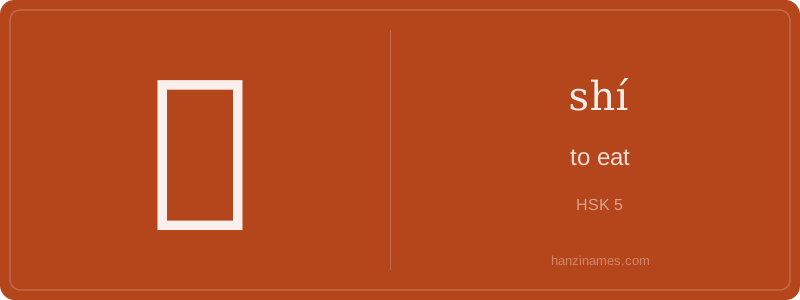
In contemporary China, 食 appears ubiquitously: on food delivery apps (e.g., 美团外卖, Meituan Waimai), government food safety campaigns (食品安全宣传周), and classical idioms like 自食其果 (zì shí qí guǒ, ‘to reap what one sows’—literally ‘eat one’s own fruit’). It’s embedded in standardized testing (HSK 5), medical terminology (食欲, shíyù, ‘appetite’), and policy documents like the National Food Security Strategy. Historically, 食 was used in bronze inscriptions (c. 11th–3rd century BCE) to denote grain rations granted by feudal lords—documented in excavated texts such as the Mao Gong Ding inscription.
The character 食 originated as a pictograph in oracle bone script (c. 1200 BCE): a simplified drawing of a bowl (皀, later 飠) with rice grains inside, topped by a lid-like cover (亼). By the Han dynasty, it standardized into the modern form with the ‘food’ radical 飠 (a variant of 食 itself) and the phonetic component 良 (liáng). This structure reflects both semantic function and sound—verified in Shuōwén Jiězì (121 CE).
Imagine stepping into a bustling Beijing hutong at noon—the sizzle of cumin-laced lamb skewers on charcoal grills, the clatter of stainless-steel bowls, and the cheerful call 'Shí ba! Shí ba!' (‘Eat up! Eat up!’) from a grandmother urging her grandson to finish his noodles. This is where 食 lives—not as an abstract glyph, but as rhythm, ritual, and warmth. It pulses in every shared meal, from street-side dumpling stalls to ancestral tomb-sweeping offerings. Its nine strokes map centuries of agrarian reverence: food isn’t just fuel; it’s filial duty, social glue, and cultural continuity.
The character 食 appears in formal registers like ‘food safety’ (食品安全, shípǐn ānquán) and poetic ones like ‘five grains’ (五谷, wǔgǔ)—a Confucian ideal symbolizing nourishment for body and virtue. Even its alternate pronunciation sì (as in 食禄, sìlù—‘to receive official stipend’) reflects historical linkage between sustenance and state service. In modern life, seeing 食 on a restaurant sign or health inspection placard signals trustworthiness—it’s the quiet anchor of daily legitimacy.
HSK Level 5 learners encounter 食 not only as a verb but as a radical governing over 100+ characters—from 饭 (fàn, cooked rice/meal) to 饱 (bǎo, full) and 饥 (jī, hungry). Its presence transforms meaning: add 氵(water) → 饮 (yǐn, to drink); add 宀 (roof) → 宿 (sù, to lodge)—hinting at ancient associations between shelter, sustenance, and survival. Mastering 食 unlocks lexical families central to discussing health, economy, and ethics in Chinese discourse.
Example Sentences
Common Compounds
Similar Characters — Don't Mix These Up
Your First Step into Chinese Culture: Get a Chinese Name
Every journey into Chinese begins with a name. Use our free Chinese name generator to create a meaningful, personalized Chinese name that fits you perfectly.
Get My Chinese Name →