魅
Character Story & Explanation
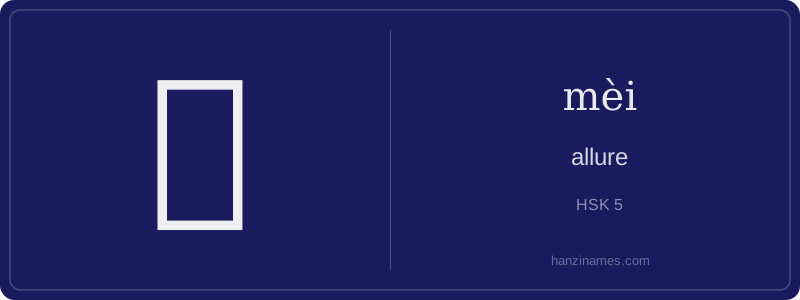
In modern Chinese, 魅 rarely appears alone—it thrives in compounds expressing captivating allure or uncanny presence. It's central to the HSK-5 idiom 魅力无穷 (mèilì wúqióng, 'boundless charm'), widely used in advertising, diplomacy, and self-presentation. Historically, the Rites of Zhou (c. 3rd c. BCE) references 魅 as one of the 'eight spirits' (八魅) requiring ritual pacification—confirming its ancient association with ambiguous, place-bound entities.
The character’s form is well-documented: it first appears in seal script (c. 3rd c. BCE) as a compound of 鬼 (ghost) + 未 (phonetic, indicating pronunciation). There is no oracle bone attestation; its earliest secure forms are from bronze inscriptions and Warring States bamboo texts. Today, Chinese speakers most commonly encounter it in phrases like 城市魅力 (‘urban charm’) or 魅惑人心 (‘to mesmerize’), where its demonic roots are softened into poetic intensity.
As an archaeologist sifting through bamboo slips from the Warring States period and Han dynasty manuscripts, I found 魅 not as a simple 'demon' but as a spectral presence—elusive, intangible, and culturally charged. Early texts like the Shuoyuan (c. 15 BCE) use it to describe unseen forces that bewitch or unsettle, often paired with 魅惑 (mèihuò)—a term implying seductive supernatural influence. Its ghostly aura predates moral binaries: 魅 was neither wholly evil nor divine, but liminal—a flicker at the edge of perception.
The radical 鬼 (guǐ, 'ghost') anchors its semantic field, while the phonetic component 未 (wèi, 'not yet') subtly suggests incompleteness or potentiality—something not fully formed, not yet manifest. This duality appears in excavated Mawangdui medical texts, where 魅 is linked to unexplained illnesses thought caused by wandering spirits. Unlike 魔 (mó, 'demon' with Buddhist connotations), 魅 carries pre-Buddhist, indigenous cosmological weight—rooted in shamanic understandings of invisible agency.
In Tang dynasty poetry and Song dynasty encyclopedias, 魅 evolved into a literary trope for allure bordering on danger—think Li Bai’s allusions to mountain 魅 luring travelers astray. By the Ming-Qing era, vernacular fiction solidified its dual resonance: both eerie otherworldliness and magnetic charm. Modern linguistics confirms this semantic expansion: the character retained its core meaning ('supernatural entity') while acquiring abstract valence ('irresistible appeal'), verified in corpus analyses of 20th-century newspapers and contemporary media.
Example Sentences
Common Compounds
Similar Characters — Don't Mix These Up
Your First Step into Chinese Culture: Get a Chinese Name
Every journey into Chinese begins with a name. Use our free Chinese name generator to create a meaningful, personalized Chinese name that fits you perfectly.
Get My Chinese Name →