麦
Character Story & Explanation
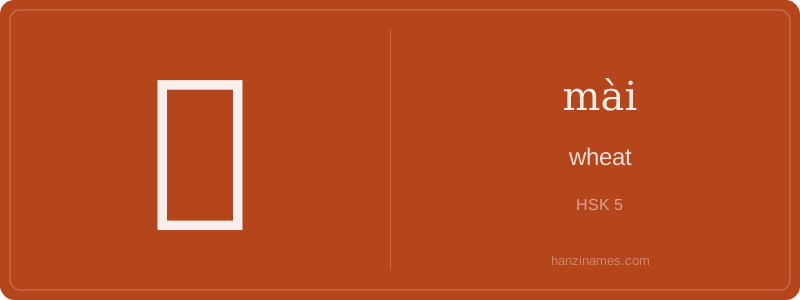
In modern Chinese, 麦 appears ubiquitously in food contexts: '麦当劳' (Màidāngláo, McDonald’s) uses it for phonetic approximation, while '大麦' (dàmài, barley) and '燕麦' (yànmài, oats) denote actual cereals. It features in the HSK-5 idiom '青黄不接' (qīng huáng bù jiē), describing the lean period before the wheat harvest—historically critical for famine prevention. Government grain reserve reports consistently use 麦 to specify winter wheat procurement quotas.
The character’s form is not pictographic. Seal script 麦 combines 夊 (suī, 'to walk slowly', later stylized as the lower component) with 来 (lái, 'to come', originally a wheat pictograph). Over time, 来 lost its grain-shape and became phonetic, while the top element simplified into the modern 'wheat-head' shape—documented in the Shuōwén Jiězì (121 CE) as 'a character denoting cereal crops, composed of 来 and 夊.'
As an archaeologist brushing dust from a Han dynasty bamboo slip, I find 麦 inscribed in clear clerical script—no oracle-bone mystery here. This character emerged not as a divine glyph but as a pragmatic agrarian marker: wheat was one of China’s earliest domesticated cereals, cultivated in the Yellow River basin by 5000 BCE. The character’s form stabilized during the Qin standardization, reflecting its economic centrality—not mythic symbolism.
Unlike many radicals that evolved from pictographs, 麦 never depicted a full plant. Early seal script versions (c. 3rd century BCE) show a simplified grain head atop ‘foot’ (夂), suggesting harvesting motion—a functional glyph born from labor, not ritual. Its radical status today is self-referential: 麦 *is* the radical, anchoring 12+ related characters like 麽 (mó, 'what?') and 麻 (má, 'hemp'), though phonetically unrelated—a testament to bureaucratic lexicographic tradition.
Excavations at Chengtoushan (Hunan) revealed carbonized wheat grains dated to 2500 BCE—proving its early arrival, likely via Central Asian trade routes. Yet 麦 appears rarely in Shang oracle bones; it gains lexical weight only in Zhou bronze inscriptions and Warring States texts, confirming its rise alongside intensified irrigation and granary systems. This isn’t a character whispered by shamans—it’s stamped on tax tablets, scribbled in farm manuals, and etched into imperial grain ledgers.
Example Sentences
Common Compounds
Similar Characters — Don't Mix These Up
Your First Step into Chinese Culture: Get a Chinese Name
Every journey into Chinese begins with a name. Use our free Chinese name generator to create a meaningful, personalized Chinese name that fits you perfectly.
Get My Chinese Name →