亦
Character Story & Explanation
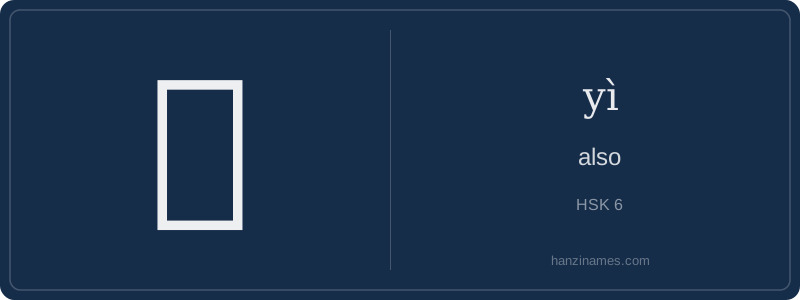
In modern Chinese, 亦 appears almost exclusively in formal writing, literary prose, and fixed idioms—never in casual speech. It’s common in academic papers, legal documents, and classical-style poetry. Well-documented phrases include 亦步亦趋 (yì bù yì qū, 'to follow slavishly') and 不亦乐乎 (bù yì lè hū, 'isn’t this delightful?', from the Analects). Its usage declined sharply after the May Fourth Movement, replaced by 更 (gèng) or 也 (yě) in everyday contexts.
The character has no verified pictographic origin. Oracle bone and bronze inscriptions show no clear precursor; its earliest forms are already stylized. Instead, it emerged as a phonosemantic compound in early script reform, with 亠 indicating abstraction and the lower part (originally possibly a variant of 大) suggesting ‘equal standing.’ Today, Chinese learners most often meet it in HSK 6 reading passages or when studying classical quotations.
As an archaeologist sifting through bamboo slips from the Warring States period, I found 亦 inscribed in elegant clerical script—not as a standalone word, but as a grammatical keystone. Its presence signals equivalence or parallelism: ‘X is so; Y is also so.’ Unlike modern ‘also’—a casual additive—it carried logical weight, often framing philosophical equivalences in texts like the Mencius and Zhuangzi, where identity and duality were central themes.
This character resists pictorial origins; no oracle bone form survives, and its earliest attestation (in bronze inscriptions of the late Western Zhou) shows it already abstracted—a pair of symmetrical dots beneath the 亠 roof, suggesting balanced inclusion. The radical 亠 (‘lid’ or ‘cover’) implies conceptual containment: not mere addition, but shared category membership—‘X belongs here; Y, too, belongs here.’
By the Han dynasty, 亦 had crystallized into a high-register adverb, reserved for formal writing and classical argumentation. Its scarcity in spoken vernacular—even today—reveals its enduring role as a marker of rhetorical precision. To encounter 亦 is to witness ancient Chinese logic in ink: not ‘and also,’ but ‘by the same token.’ It’s linguistic archaeology made visible—six strokes encoding millennia of syntactic thought.
Example Sentences
Common Compounds
Similar Characters — Don't Mix These Up
Your First Step into Chinese Culture: Get a Chinese Name
Every journey into Chinese begins with a name. Use our free Chinese name generator to create a meaningful, personalized Chinese name that fits you perfectly.
Get My Chinese Name →