仙
Character Story & Explanation
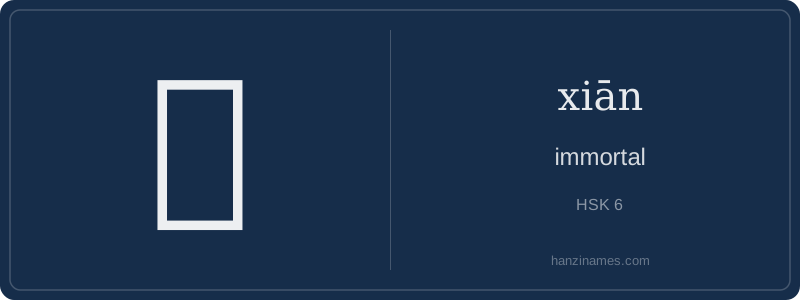
The character 仙 is widely used in contemporary Chinese for poetic, aesthetic, or reverent effect—e.g., in brand names (仙居, Xiānjū County, famed for its fairy-tale landscapes), literary nicknames (Li Bai was historically called 'Poetry Immortal' 诗仙), and idioms like 仙女下凡 (a fairy descends to earth—used humorously for someone stunningly beautiful). It appears in classical texts like the *Zhuangzi* and *Shenxian Zhuan* (Biographies of Divine Immortals, 4th c. CE), cementing its Daoist roots.
The character combines the radical 亻 (person) and the phonetic component 山 (shān, mountain). This structure is documented in Han dynasty clerical script and reflects the ancient association of immortals with sacred mountains—places of seclusion, cultivation, and spiritual ascent. No oracle-bone form exists; its earliest secure attestation is in Warring States bamboo slips.
Picture a mist-shrouded morning at Mount Qingcheng in Sichuan, where Taoist temples nestle among ancient cypress trees. An elderly qigong master moves slowly through the courtyard, his white robe brushing dew-damp stone. A young visitor asks, 'Are you an immortal?' He smiles gently and replies, 'I cultivate *xiān*—not eternal life, but harmony with the Dao.' Here, 仙 isn’t fantasy—it’s a lived ideal: transcendence through virtue, breath, and stillness.
In modern China, 仙 appears everywhere—not just in temple inscriptions, but on tea packaging ('mountain-immortal tea'), indie music album covers, and even café names like 'Cloud-Immortal Café' (云仙咖啡). It evokes elegance, timelessness, and quiet mastery. Unlike Western 'immortals' tied to power or divinity, 仙 suggests effortless grace—like a crane gliding on thermal winds or ink bleeding perfectly across rice paper.
This character carries millennia of philosophical weight. From Zhuangzi’s butterfly dream to Tang dynasty poets who called themselves 'wine-immortals' (酒仙), 仙 reflects a uniquely Chinese path to transcendence: not by escaping the world, but by refining one’s presence within it. Even today, calling someone 仙-like—say, a grandmother who bakes mooncakes with preternatural calm—is the highest compliment: serene, ageless, deeply rooted yet unbound.
Example Sentences
Common Compounds
Similar Characters — Don't Mix These Up
Your First Step into Chinese Culture: Get a Chinese Name
Every journey into Chinese begins with a name. Use our free Chinese name generator to create a meaningful, personalized Chinese name that fits you perfectly.
Get My Chinese Name →