伐
Character Story & Explanation
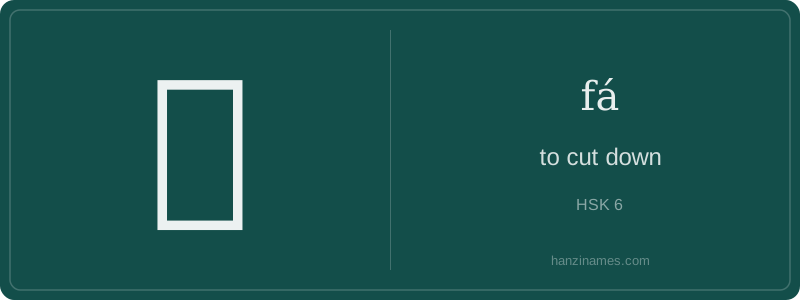
伐 appears frequently in classical Chinese historiography and philosophy, most notably in idioms like 东征西伐 (dōng zhēng xī fá, 'campaign eastward and attack westward'), describing the Zhou dynasty’s expansion, and in Confucius’ Analects 7.22: '不伐不矜' (bù fá bù jīn) — 'not boasting, not self-praising.' It remains in modern usage primarily in literary, academic, or rhetorical contexts — e.g., news headlines about geopolitical criticism ('伐异') or historical documentaries on ancient warfare.
The character’s form dates to the bronze script (c. 11th–3rd century BCE), where it depicts a person (亻) wielding an axe-like weapon (戊). Archaeological inscriptions confirm its early association with military expeditions — not tree-cutting — suggesting the 'cutting down' meaning originated metaphorically from conquest, later extending to forestry. No oracle bone variant survives, but Shang-Zhou bronze inscriptions consistently use 伐 for 'punitive expedition.'
The Chinese character 伐 (fá) literally means 'to cut down' — originally referring to felling trees, but historically extended to military conquest, as in 'attacking and subduing an enemy state.' Its radical 亻 (person) signals human agency, while the phonetic component 戊 (wù, an ancient weapon/astrological term) hints at martial context. This semantic expansion mirrors how English uses 'cut down' metaphorically — e.g., 'cut down a rival' — though 伐 carries stronger connotations of justified, large-scale action, often sanctioned by authority.
In classical Chinese texts like the *Zuo Zhuan* and *Records of the Grand Historian*, 伐 consistently denotes punitive military campaigns launched by feudal lords or dynastic rulers against rebellious vassals or 'uncivilized' states — not mere raids. Unlike the morally neutral English 'attack,' 伐 implies legitimacy: one 'fá-s' only when upholding ritual order (lǐ). This reflects Confucian political ethics, where violence must be righteous and proportionate — closer to the Western concept of 'just war' than to generic aggression.
Western equivalents vary by context: 'to fell' (forestry), 'to subdue' (military history), or 'to censure' (rhetorical usage, as in 伐善 — 'boasting of one’s virtues'). In Shakespearean English, 'to hew down' evokes similar imagery — physical and moral severance. Yet 伐 rarely appears in modern spoken Mandarin outside fixed expressions or formal writing, making it a high-register lexical item akin to English 'besiege' or 'levy war' — precise, archaic-tinged, and culturally freighted with historical gravity.
Example Sentences
Common Compounds
Similar Characters — Don't Mix These Up
Your First Step into Chinese Culture: Get a Chinese Name
Every journey into Chinese begins with a name. Use our free Chinese name generator to create a meaningful, personalized Chinese name that fits you perfectly.
Get My Chinese Name →