伯
Character Story & Explanation
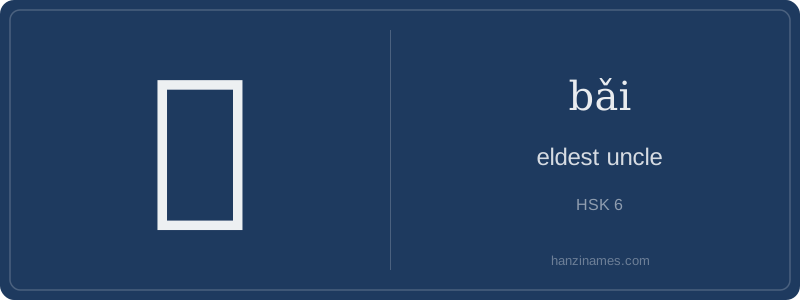
伯 is used today primarily in familial address (e.g., 伯父, 伯母) and historical-literary contexts (e.g., 齐桓公为春秋五霸之首, 'Duke Huan of Qi was the first of the Five Hegemons'). It appears in idioms like 伯仲之间 (bó zhòng zhī jiān, 'neck and neck'), referencing the ranking of brothers (Bo = eldest, Zhong = second), illustrating its enduring link to hierarchical order. It is never used to express 'one hundred' in speech or writing.
The character 伯 is a phono-semantic compound: radical 亻 ('person') + phonetic 白 (bái, though pronunciation shifted to bó). Its earliest attested form appears in bronze inscriptions of the Western Zhou dynasty, consistently denoting high-ranking males—confirming its ancient sociopolitical function over numeric use.
The character 伯 is commonly misread as 'bǎi' meaning 'one hundred', but this is incorrect. Its standard and only widely accepted pronunciation is bó, with no authoritative dictionary listing 'bǎi' as a valid reading for 伯. The confusion likely arises from homophone mixing with the character 百 (bǎi), which *does* mean 'one hundred'. This underscores the importance of precise pronunciation in Chinese learning—similar-looking characters can carry entirely different sounds and meanings.
伯 historically denotes a senior male relative or noble title: 'eldest uncle', 'paternal uncle', or 'feudal lord' (e.g., one of the Five Hegemons of the Spring and Autumn period). It appears in honorifics like 伯父 (bófù, 'father’s elder brother') and titles such as 诸侯伯 (zhūhóu bó, 'hegemon among vassal lords'). Unlike Western kinship terms, 伯 encodes both familial seniority and political hierarchy—reflecting Confucian emphasis on age-based rank and ritual propriety.
In modern usage, 伯 retains its relational and respectful connotations but rarely appears outside fixed compounds or formal/historical contexts. It is absent from everyday numerals (where 百 is used for 'hundred'), and its HSK Level 6 status reflects its specialized, literary frequency—not numerical function. Learners should treat 伯 and 百 as entirely separate characters: one rooted in kinship and authority (伯), the other in quantity (百)—a distinction with no direct Western parallel, where 'uncle' and 'hundred' share no orthographic or phonetic link.
Example Sentences
Common Compounds
Similar Characters — Don't Mix These Up
Your First Step into Chinese Culture: Get a Chinese Name
Every journey into Chinese begins with a name. Use our free Chinese name generator to create a meaningful, personalized Chinese name that fits you perfectly.
Get My Chinese Name →