伺
Character Story & Explanation
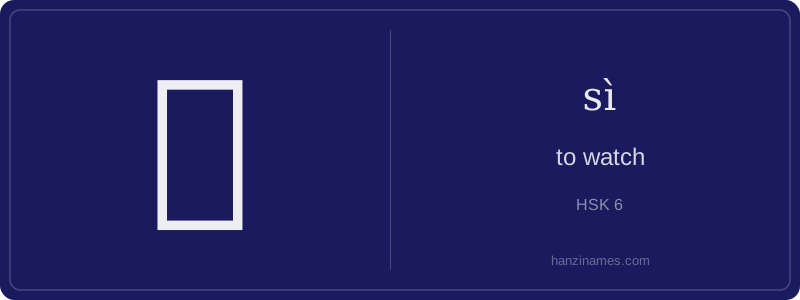
伺 is rarely used alone in modern Mandarin but appears in fixed compounds like 伺机 (sìjī, 'to wait for an opportunity') and 伺候 (sìhòu, 'to attend to someone respectfully'). It features in classical texts such as the *Zuo Zhuan*, where officials are described as 伺其隙 ('watching for [the ruler’s] opening') to offer counsel. The idiom 伺机而动 ('wait for the right moment and then act') remains common in business and political commentary today.
The character evolved from seal script, where 司 (sī) depicted a hand holding a writing tablet—symbolizing administration and oversight—and 亻 emphasized human involvement. No oracle-bone form survives, but by the Warring States period, 伺 consistently meant 'to observe with intent'. Today, Chinese learners encounter it most often in news reports about intelligence operations or historical dramas depicting palace intrigue.
The Chinese character 伺 (sì) conveys the subtle, intentional act of watching—often with anticipation, vigilance, or quiet observation. Unlike passive 'looking', 伺 implies purpose: waiting for an opportunity, monitoring behavior, or attending discreetly. Its radical 亻 (person) signals human agency, while the right component 司 (sī) originally meant 'to manage' or 'to oversee', reinforcing authority and intentionality. This layered meaning reflects Confucian values of attentive service and situational awareness.
In classical and modern usage, 伺 frequently appears in formal or literary contexts—not casual speech—evoking surveillance, strategic observation, or dutiful waiting. It appears in historical texts describing court attendants ‘watching for the emperor’s signal’ or spies ‘lying in wait’. Western equivalents like 'to watch' lack this connotation of calculated patience; 'to surveil' is closer but overly technical, while 'to lie in wait' captures only the tactical dimension—not the respectful, service-oriented nuance found in phrases like 伺候 (sìhòu, to attend to).
Culturally, 伺 embodies a distinctly East Asian blend of deference and perceptiveness. In contrast to Western individualism that prizes direct assertion, 伺 reflects relational intelligence: observing before acting, reading cues to serve appropriately. This mirrors practices like Japanese *kansatsu* (keen observation in tea ceremony) or Korean *jeong* (attentive care), yet 伺 is uniquely tied to hierarchical duty and temporal readiness. Its HSK-6 status confirms its role in advanced comprehension—not as everyday vocabulary, but as a semantic keystone for understanding power dynamics, etiquette, and narrative tension in Chinese literature and media.
Example Sentences
Common Compounds
Similar Characters — Don't Mix These Up
Your First Step into Chinese Culture: Get a Chinese Name
Every journey into Chinese begins with a name. Use our free Chinese name generator to create a meaningful, personalized Chinese name that fits you perfectly.
Get My Chinese Name →